


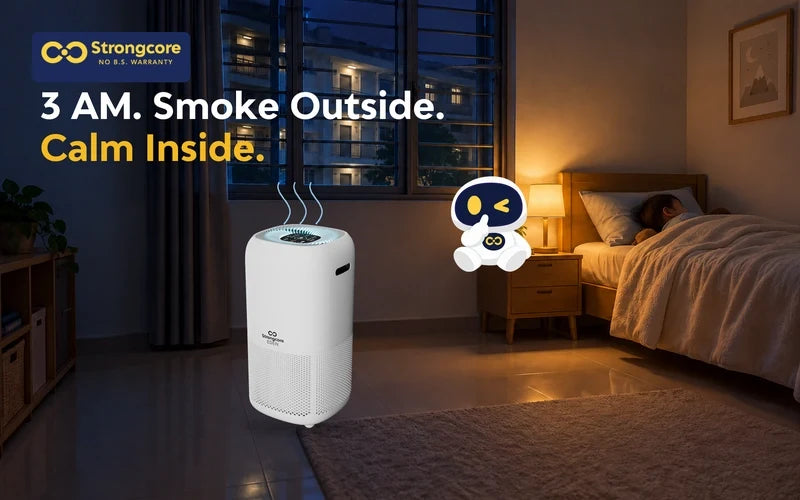

3:07 AM
The cough woke me before the smell did.
It was the dry, tight cough I've learned to dread. By the time I reached my son's room, I could smell it too: cigarette smoke, sharp and fresh, drifting in through the window louvres. Someone a few floors down was having a smoke before bed. Again.
I shut the window, switched on the fan and sat with him while he used his inhaler. He fell back asleep around 4. I didn't.
The worst part wasn't the cough. It was knowing I couldn't stop it. I can't walk into a neighbour's flat and take away their cigarette. I can close every window, but in Singapore's heat that only lasts so long. And the smoke still finds a way in.
If you're reading this at an hour like 3 AM, you're not overreacting. Secondhand smoke drifting between HDB units is one of the most common complaints Singapore families raise about their neighbours, and it hits hardest in homes with young children or someone with asthma.
This guide covers what's actually happening to the air in your flat, what the rules can and can't do for you, and how to turn your child's bedroom into the one room the smoke doesn't reach. That includes choosing the right air purifier for smoke, and what to look for so you don't end up with one that only moves the smell around.
How a Neighbour’s Smoke Gets Into Your Hdb Flat
HDB blocks are designed to breathe. Stacked windows, louvres and open corridors keep flats cool without aircon. The same airflow carries a neighbour's smoke straight to you.
The usual routes in:
- Windows above or beside a smoker. Warm smoke rises. A cigarette at a window one or two floors down can drift up and into yours, especially on still nights.
- Louvres and bedroom windows left open for airflow. These are hard to keep shut through a hot night.
- The gap under your main door. Smoking in common corridors is banned, but it still happens, and corridor smoke seeps under doors and through gates.
- Kitchen and service yard openings. These connect to shared air shafts in many blocks.
Once inside, the smell isn't the whole problem. Cigarette smoke is mostly very fine particles, much smaller than a strand of hair, plus gases. The particles stay suspended in a room long after the smell fades, and they settle into curtains, bedsheets and soft toys.
That's why opening a window or switching on a fan often doesn't fix it. A fan moves smoky air around the room. It doesn't take anything out of it.

Why Secondhand Smoke Hits Children With Asthma Harder
The harm from secondhand smoke isn't in doubt. In a May 2026 parliamentary reply, Singapore's Ministry of Health said the health harms are well established, with sustained exposure linked to respiratory illness, heart disease and cancers.
Children are more exposed than adults in the same room, for three reasons:
- They breathe faster, so they take in more air, and more of what's in it, for their body size.
- Their airways are smaller, so irritation and swelling narrow them more quickly.
- Night-time exposure lands during sleep, when a child can't move away from it and you may not notice until the coughing starts.
For a child with asthma, tobacco smoke is a well-known trigger. It irritates already sensitive airways and can set off coughing, wheezing and tightness in the chest.
Important: cleaner air reduces exposure to a trigger. It doesn't replace your child's asthma treatment. Keep following the asthma action plan from your doctor. If your child struggles to speak, their lips turn bluish, or their reliever inhaler isn't helping, seek emergency care immediately.
What the Law Can and Can’t Do for You
Many parents assume there must be a rule against this. Here's where things stand in 2026.
|
Where the smoking happens |
Is it banned? |
What you can do |
|---|---|---|
|
Common corridors, stairwells, void decks, lift lobbies |
Yes. These are among the 49,000+ public places where smoking is prohibited |
Report it to NEA with the time and location |
|
Inside a neighbour's own flat, including at a window or balcony |
No. Homes are treated as private spaces |
Talk to them, or seek help from your Town Council, grassroots leaders or community mediation |
The second row is the one that keeps parents up at night.
MPs have raised secondhand smoke from neighbouring homes in Parliament many times. In February 2026, the Ministry of Sustainability and the Environment said regulating smoking inside homes needs careful thought because it could be intrusive. Its approach is community-based: working with Town Councils and grassroots leaders to encourage smokers to be considerate. In May 2026, the government confirmed it had no current plans to regulate secondhand smoke at home, after NEA received about 600 complaints about neighbours' smoke in 2025.
So you're not alone, and you're not being unreasonable. But for now, any change depends on your neighbour's goodwill. That's why it makes sense to also protect the one space you do control: the air inside your home.

What You Can Control, Starting Tonight
You can't control your neighbour. You can reduce how much smoke reaches your child. Work through these in order.
- Keep a simple log. Note the date, the time and the room where you smell smoke. Patterns, like every night around 11 PM, help you plan around it and give you something concrete if you ask for mediation.
- Try a friendly word or a note. Many smokers simply don't realise their smoke drifts upwards. A polite note mentioning a child with asthma often works better than a complaint.
- Ask for help if that fails. Your Town Council or grassroots leaders can step in, and community mediation is available for neighbour disputes. Report any corridor or stairwell smoking to NEA.
- Close the entry points at peak times. Shut the windows and louvres facing the smoker during the hours your log shows. Fit a door draught stopper under the bedroom door.
- Wash what holds the smell. Smoke residue clings to fabric. Wash pillowcases, bedsheets and soft toys regularly.
- Clean the air that's already inside. Closing windows stops new smoke coming in. It doesn't remove what's already there. That's the job of an air purifier with the right filters.
What an Air Purifier for Smoke Actually Needs
Not every purifier handles cigarette smoke. Many just push air through a basic filter and leave the smell behind. Cigarette smoke has two parts, and a good air filter for smoke needs to deal with both.
|
Part of the smoke |
What it is |
What removes it |
What Strongcore EDEN uses |
|---|---|---|---|
|
Fine particles |
Tiny solid and liquid droplets that stay in the air and reach deep into the lungs |
A HEPA filter, and the grade matters |
Medical-grade HEPA 13, capturing 99.97% of tiny pollutants |
|
Smell and gases |
The sharp odour that lingers after the particles are gone |
Activated carbon |
Activated carbon layer to reduce smoke odour |
Then check three more things:
- Speed (CADR). Smoke comes in waves, so the purifier needs to clear a room fast. EDEN delivers 400m³/h of clean air and covers rooms up to 800 sq ft, cycling a room's air about every 10–12 minutes.
- A sensor that reacts on its own. You won't always notice a new wave of smoke, especially while you're asleep. EDEN's Auto Mode adjusts fan speed when air quality changes, and Turbo Mode clears the room fast when you smell smoke.
- Proof you can see. EDEN's smart display shows air quality in real time, so you can watch the reading drop instead of guessing.
Being honest: no air purifier removes every gas in tobacco smoke. A purifier works best alongside the steps above, not instead of them. What it does well is pull the fine particles out of the air your child breathes and cut the lingering smell, all night, without you having to wake up and act.

Setting up a Safe Air Bedroom for the Night
The goal is simple: by the time smoke arrives at 3 AM, the purifier is already running, already reacting, and quiet enough that nobody wakes up.
Where to put it
- Place it in your child's bedroom, between the bed and the window where smoke usually comes in.
- Leave some open space around it so air can flow in and out freely. Don't push it into a corner or behind curtains.
- Point the airflow across the room, not straight at your child's face.
- If your living room is open to the bedroom corridor, EDEN's 800 sq ft coverage can also handle the shared space in the evening, before you move it in at bedtime.
Your night routine with EDEN
|
When |
What to do |
EDEN feature that helps |
|---|---|---|
|
Bedtime |
Close the smoker-facing windows and switch EDEN to Auto Mode |
Auto Mode reacts on its own to changes in air quality |
|
Lights out |
Dim the night light to the lower setting |
Soft night light with two brightness levels, enough to check on your child |
|
Through the night |
Leave it running, so it's there when the smoke arrives |
Quiet performance as low as 30 dB |
|
If you smell smoke |
Switch to Turbo Mode for a fast clear, then back to Auto |
Turbo Mode plus a 400m³/h CADR |
|
Morning |
Check the reading on the display |
Smart display shows air quality in real time |
Common Questions
"Will an air purifier for smoke get rid of the smell completely?" It will cut it down significantly, but not instantly or perfectly. EDEN's activated carbon layer reduces smoke odour, and its HEPA 13 filter captures the fine particles. Close the windows the smoke comes through and let it run in Auto, and the room clears much faster than with a fan or an open window.
"Isn't a fan or the aircon enough?" No. A fan only moves smoky air around the room. Most home aircon units recirculate indoor air through a basic dust filter that isn't designed to catch fine smoke particles or odour. You need a HEPA filter and an air filter for smoke odour, meaning activated carbon.
"Will it wake my child?" EDEN runs as quietly as 30 dB in its quietest setting, about the level of a soft whisper. The night light dims to a low glow.
"Is it safe around young children?" EDEN has a child lock, so little hands can't change the settings or turn it off.
"Will it help my child's asthma?" It reduces exposure to airborne triggers like smoke particles in the room. It doesn't treat asthma. Keep following your doctor's asthma action plan.
"How often do I change the filter?" The filter lasts up to 6 months, and EDEN's filter sensor tells you when it's time, so you don't have to guess.

You Can’t Control the Smoke. You Can Control the Air Your Child Breathes.
No parent should have to sit up at 3 AM listening for a cough. Until the rules change or your neighbour does, your child's bedroom is the one place you can make safe, and it starts with what's in the air.
Strongcore EDEN combines HEPA 13 filtration and activated carbon, so it captures the fine particles and cuts the smell. It reacts on its own in Auto Mode and runs as quietly as 30 dB through the night, so you can finally sleep too. And if it's not right for your home, Strongcore's 1-year SwiftSwap warranty and 30-day free returns mean you're not taking a risk.
Create a safe air sanctuary at home, get Strongcore EDEN now!


Share:
How to Choose a Blender in Singapore: The Specs That Matter (and the Ones That Don't)