


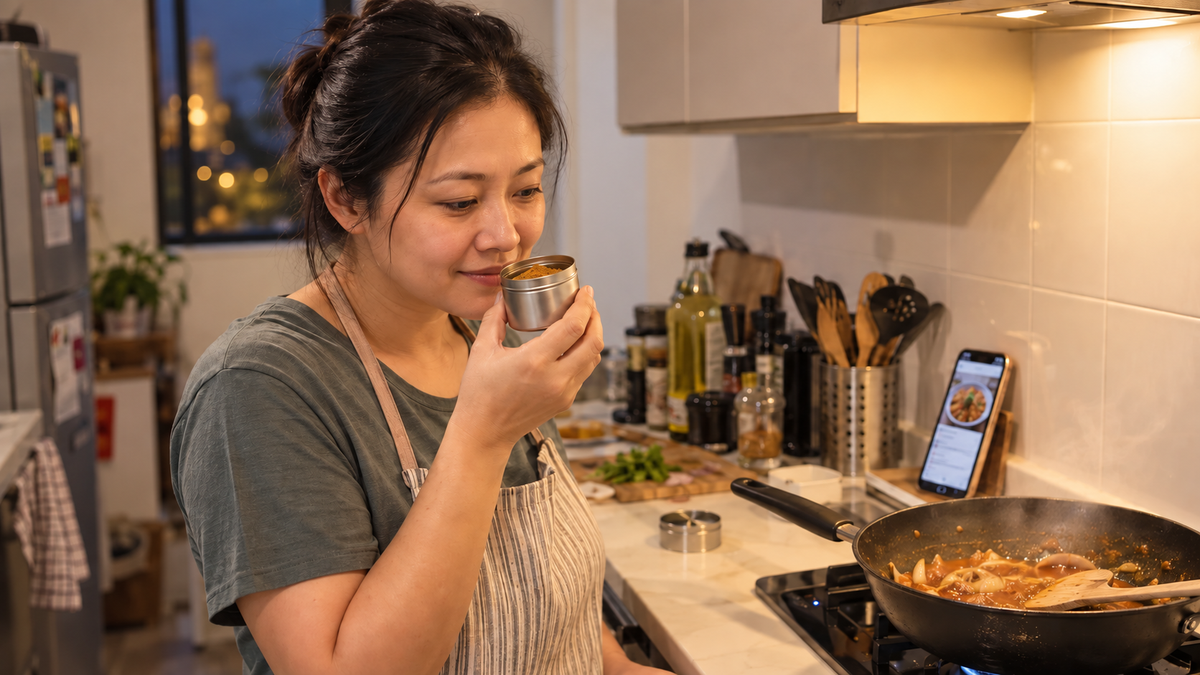

It's Sunday and you're making rendang. The recipe says two teaspoons of ground coriander, so you reach for the tin at the back of the cupboard — the one with no date on it that you're fairly sure predates your current flat. You unscrew the lid and sniff.
Nothing. A faint dusty sweetness, like cardboard.
You use it anyway. Then you add a third teaspoon, because it tastes flat. Then a fourth. The rendang comes out fine. Just fine — not the version you remember from your mother's kitchen, and you've never been able to work out what's missing.
If you cook with spices in Singapore, this is the pattern:
-
The tin has no grind date, only a best-before that tells you nothing about when it was actually ground
-
You keep adding more to compensate, which makes the dish gritty without making it taste stronger
-
Premixed blends cost S$6–9 a packet for something that's often padded with rice flour, salt and colouring
-
Everything in your cupboard is quietly dying in a kitchen that sits at 30°C and 80% humidity year-round
Here's what the spice aisle doesn't advertise: ground spice starts losing its flavour the second it's ground, and most of what's on the shelf was ground months before it reached you. You're not a bad cook. You've been seasoning with the ghost of a spice.
By the end of this, you'll know which spices are genuinely worth grinding fresh — because not all of them are — how to grind them properly, and the two-jar method for a proper rempah.
What’s Actually Happening in That Tin
Spice flavour lives in volatile aromatic oils. "Volatile" is doing the heavy lifting in that sentence: it means the compounds evaporate at room temperature, on their own, without you doing anything.
A whole coriander seed keeps those oils sealed inside a hard shell. Grind it, and you multiply the exposed surface area enormously — and every one of those new surfaces starts venting aroma into the air. That lovely smell when you open a fresh packet of ground spice? That's the product leaving.
Whole spices hold their character for a year or more. Ground spices are noticeably weaker within two to three months, and a Singapore kitchen accelerates all of it — heat, humidity and a cupboard above the stove are the three worst things you can do to ground spice.
So the maths is unkind. If a tin was ground at the factory, shipped, warehoused, shelved for a few months and has then sat in your cupboard for a year, you are cooking with something that lost most of its point long before you opened it.

Why Your Blender and Your Mortar Both Fall Short
A blender jug is the wrong shape for dry goods. It's wide and tapered, built so liquid circulates back down into the blades. Drop in a tablespoon of peppercorns and they scatter across a base far wider than the blade's reach, so the blade spins through mostly empty air while the spices sit at the edge, untouched.
People assume more power will eventually get through it. It won't — a stronger motor spins the same blade through the same empty air, faster. It's a geometry problem, not a wattage problem.
The mortar and pestle is the opposite case: it works beautifully, and that's precisely why it sits unused. Ten minutes of pounding for a tablespoon of ground coriander is a weekend activity, not a Tuesday one. The tool most people own is the one they've decided they don't have time for — which is how you end up back at the tin.
What A Dedicated Grinder Cup Changes
The Strongcore TRITON ships with three jars, and the one that matters here is the 300ml grinder cup — narrow, straight-sided and short, so nothing can escape the blade's working radius. Every seed in the cup stays in the strike zone.
It runs a 2-blade S-shape grinding attachment, a different geometry from the 4-blade 3D blending attachment used in the 1L jar. Same base, different tool — which is the distinction most "3-in-1" listings quietly skip, because they change the jar and reuse the same blade.
The 380W motor at 24,000 RPM is more than enough here, because dry grinding is a speed problem, not a torque problem. You need the blade moving fast enough to fracture a seed on contact, not strong enough to push through a load.
What that means at the counter:
-
Pulse control sets the texture — coarse cracked pepper, or a fine powder for a curry base
-
304 stainless steel blades stay sharp and don't hold oil residue between spices
-
The cup detaches, so ground spice tips straight into the pan
-
Auto safety lock — the motor won't spin unless the cup is locked in place
CPSO certified and covered by SwiftSwap: send a video, the team verifies, a replacement arrives at your door. No repair queue.
Not sure which jar does what? [See the jar-to-task cheat sheet →]
The Toast-And-Grind Method
This is the part that does the actual work. Grinding fresh is good; toasting first is what makes people stop and ask what you did differently.
① Toast the whole spices dry. No oil. A dry pan over medium-low heat, spices in a single layer, moving constantly. Coriander, cumin, fennel and peppercorns take 60–90 seconds — you're waiting for the moment the smell changes from raw to nutty. That's your cue, and it arrives faster than you expect. Burnt spice is bitter and unfixable.
② Let them cool completely. This is the step everyone skips. Warm spices release oil, and oil turns a fine grind into a gummy paste that coats the cup. Give them five minutes on a cold plate.
③ Grind in short pulses, not one long run. Two or three seconds at a time, with a shake of the cup in between. Continuous running heats the blade, and heat drives off the aromatics you just spent 90 seconds developing. Keep to per batch and of continuous operation.
④ Grind what you need, not what you might need. The entire point is freshness. A week's worth is the sensible ceiling.
⑤ Clean it between strong spices. A tablespoon of uncooked rice, pulsed for a few seconds, lifts residual oil and aroma. Tip it out, wipe with a dry cloth. Chilli and cumin will otherwise haunt whatever you grind next.

The Rempah Problem, and the Honest Two-Jar Answer
A rempah isn't a dry spice blend. It's a wet paste — shallots, garlic, ginger or galangal, lemongrass, fresh or soaked dried chilli, often belacan and candlenuts. A dry grinder cup is the wrong tool for the wet half of that, and any guide that tells you otherwise hasn't made one.
The workflow that actually works uses two jars:
Grinder cup (dry, first): whole coriander, cumin, fennel, peppercorns, candlenuts, and soaked-then-dried chilli if you want it fine. Toast, cool, grind to powder. Tip out.
Chopper bowl (wet, second): shallots, garlic, ginger or galangal, lemongrass, belacan. Pulse in the 500ml chopper bowl with its 1-shape blade until you have a rough paste. A splash of oil helps it move.
Then combine — fold the dry powder through the wet paste, and fry the whole thing off until the oil splits.
Two jars, one base, one wash. That's genuinely faster than a mortar and closer to the real texture than a jug blender, which tends to turn a rempah into a watery purée because it needs liquid to circulate at all.
Which Spices Are Actually Worth Grinding Fresh?
Not all of them. Here's the honest sort.
Always worth it — the difference is obvious
-
Black peppercorns. The single biggest upgrade in this list. Pre-ground pepper is barely the same ingredient
-
Coriander seed. Loses aroma fast; central to curry and rendang
-
Cumin. Toasted and ground fresh, it's a different spice entirely
-
Fennel, star anise, cardamom, cloves. All high in volatile oils
-
Dried chilli. Control your own heat and coarseness
Worth it if you cook these dishes often
-
Candlenuts and nuts for rempah and sauces (the grinder cup handles nut grinding)
-
White pepper for local soups and bak kut teh
-
Whole nutmeg, which fades very quickly once grated
Don't bother
-
Turmeric and ginger powder. Drying them properly at home isn't practical — buy these ground
-
Paprika and chilli powder in bulk. Already a powder by nature; fresh grinding gains you little
-
Cinnamon bark. Hard on a blade grinder and rarely worth the effort — buy it ground, or use the whole stick
Still unsure where to start? Buy whole peppercorns and whole coriander first. If those two don't convince you within a week, the rest won't either.
The Questions People Ask Before Buying
"Will I actually taste the difference, or is this a food-writer thing?" Pepper and cumin are the fair test, and both are unmistakable — toast cumin, grind it, and smell it beside your tin. If you cook curries, rendang or anything with a spice base more than twice a month, you'll notice it in the first dish. If you season with salt and soy sauce, honestly, you won't.
"How is this different from just buying a cheap spice grinder?" Most budget grinders are a single sealed cup with a fixed blade and no safety lock — and when the motor goes, the whole unit goes. This is one 380W base that also carries a 1L blending jar and a 500ml chopper bowl, with 304 stainless steel blades and an auto safety lock that stops the motor running unless the jar is locked in place.
"How do I stop the cup smelling of chilli forever?" Pulse a tablespoon of uncooked rice, tip it out, wipe dry. Thirty seconds. The 304 stainless blades don't hold oil the way lower-grade steel does, which is most of why the smell lingers in cheap units.
"Can it grind wet things — fresh turmeric, lemongrass, belacan?" Not in the grinder cup. That's what the 500ml chopper bowl is for. Using a dry cup for wet aromatics is the fastest way to disappoint yourself and gum up a blade.
"What if it stops working?" SwiftSwap warranty — send a video via WhatsApp, the team verifies, a replacement is delivered to your door. A new unit, not a repair ticket. CPSO certified.

You're here because your cooking tastes flatter than the version you remember, and you've been blaming the recipe.
It isn't the recipe. Ground spice starts dying the moment it's ground, and most of what's in your cupboard was stale before you brought it home. Nothing you do at the stove recovers that.
TRITON's answer is a jar built for the job rather than a jug borrowed from another one. A 300ml grinder cup narrow enough to keep every seed inside the blade's reach. A 2-blade S-shape grinding attachment, not the blending blade in a smaller cup. 380W at 24,000 RPM — fast enough to fracture a peppercorn on contact. 304 stainless steel blades that stay sharp and don't hold yesterday's chilli. Pulse control for grind size, and an auto safety lock so the motor won't run unless the cup is locked. CPSO certified, covered by SwiftSwap.
And the honest note: if you cook from packets and jars, this won't change your life. If you make curry, rendang, soup bases or rempah — or you just want pepper that tastes like pepper — start with whole coriander and whole peppercorns and judge it on the first dish.
The whole spices in your cupboard are fine. It's the ground ones that are running out of time.


Share:
Why Your Cheap Hand Blender Died in 6 Months (And What to Buy Instead)
Do You Really Need a Digital Kettle? Why Most Singapore Homes Just Need a Fast, Simple One