

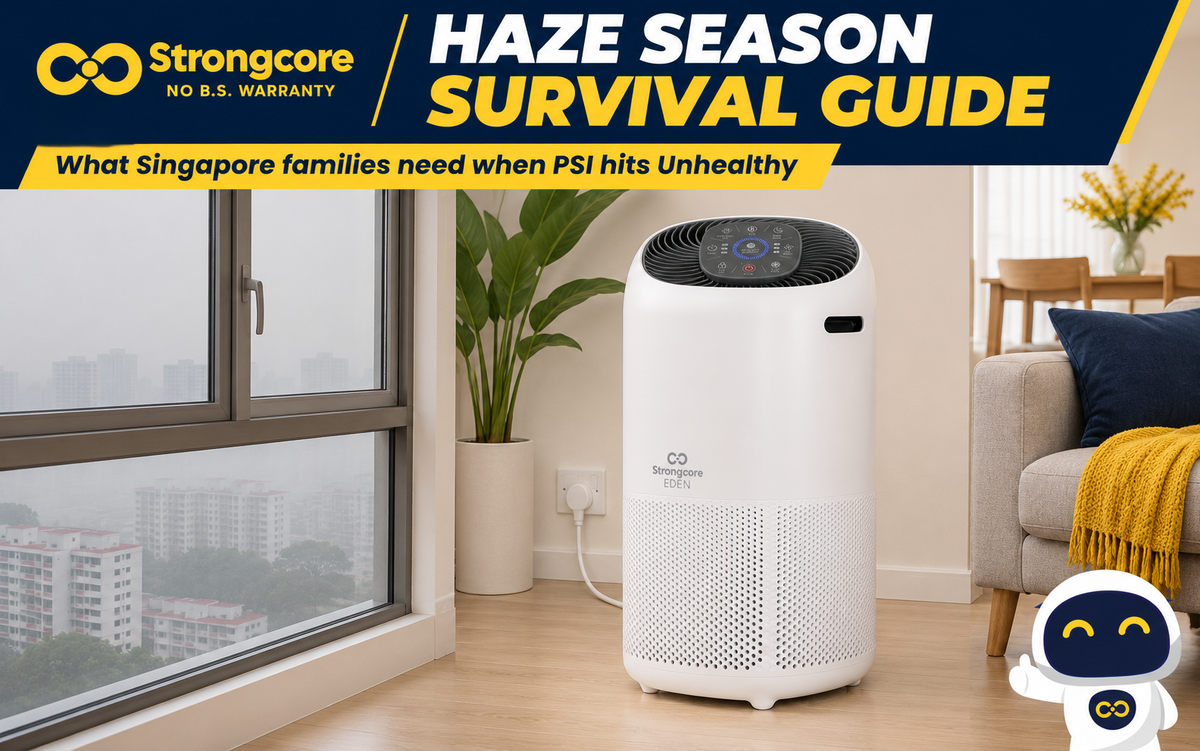

It’s 6.40am. You open the curtains and notice the block opposite looks a little hazy around the edges. Your phone buzzes: myENV shows the 24-hour PSI at 168. From the next room comes that familiar dry cough, and you already know what today calls for.
The good news? You’ve done this before, and you’re better prepared than you think. October 2026 brought Singapore its longest stretch of unhealthy air since 2015, with the 24-hour PSI reaching 229 in the central region and 230 in the west. Families across the island got through it, and many came out with a clear plan for keeping their children comfortable, healthy and learning at home. This guide brings those lessons together so the next hazy morning feels manageable, not worrying.
A couple of notes on the changes: I softened the sensory details (“gone soft at the edges” became “a little hazy”) and turned the cough into a cue for action rather than alarm. The second paragraph now frames the October figures as something families overcame, then points forward to the guide’s practical value. Since those PSI figures are central to the hook, it’s worth double-checking them against NEA’s records before publishing.
And so many families scrambled the same way:
-
Queuing at three pharmacies for N95 masks, then finding none fit a six-year-old's face
-
Shutting every window and turning on the aircon — only to realise the aircon recirculates the same hazy air
-
Watching an old purifier hum away with no idea whether it was doing anything at all
-
Lying awake at 2am listening to a child's breathing, wondering if tonight is the A&E night
Here's what nobody tells you: many families only buy an air purifier once the haze is here, when popular models sell out and the unit they settle for is often too small for the room. The protection arrives days after the exposure.
This guide fixes that. By the end, you'll know exactly when haze is most likely, what to do at every PSI level, and how to make your home the one place the haze can't follow your family — before the next season arrives.

Singapore’s Haze Calendar: When to Worry, Month by Month
Haze risk peaks from August to October, when the Southwest Monsoon's dry spell meets peak fire season in Sumatra and Kalimantan and southerly winds carry the smoke here. Authorities flagged June to October as the 2026 risk window — and every major episode in the past decade has landed inside it.
|
Month |
Haze risk |
Why |
Past episodes |
What to do now |
|
Jan |
Low |
Northeast Monsoon rains |
— |
Service purifier, check filter |
|
Feb–Mar |
Low to moderate |
Dry spell; fires in mainland Southeast Asia |
Watch myENV on hazy mornings |
|
|
Apr–May |
Low |
Inter-monsoon showers |
— |
Best time to buy: full stock, no rush |
|
Jun–Jul |
Moderate |
Southwest Monsoon begins; dry winds from Sumatra |
Jun 2013 record haze |
Set up purifier in main living area |
|
Aug |
High |
Fire season builds in Indonesia |
Aug 2026: PSI nears Unhealthy |
Buy spare filter; stock masks for adults |
|
Sep |
Peak |
Driest month; southerly winds |
2015, 2019, Sep 2026 |
Run purifier daily on Auto |
|
Oct |
Peak |
Fires continue until rains arrive |
Oct 2023; Oct 2026 (PSI 230) |
Run 24/7; keep windows shut |
|
Nov |
Moderate |
Inter-monsoon rains wash smoke out |
Nov 2019; early Nov 2026 Moderate |
Keep running until PSI stays under 50 |
|
Dec |
Low |
Northeast Monsoon |
— |
Replace filter if indicator shows |
Risk levels are based on past haze episodes, not a forecast. Dry El Niño years such as 2015, 2023 and 2026 carry a much higher risk, and haze can linger into November when the rains come late.
What to Do at Every PSI Level
Once the 24-hour PSI passes 100, children, the elderly and pregnant women should cut back outdoor exertion — and the home becomes the place your family breathes most. The first two action columns follow NEA's official health advisory; the last column is what you control at home.
|
24-hr PSI |
Band |
Healthy adults |
Children, elderly, pregnant women |
At home |
|
0–50 |
Good |
Normal activities |
Normal activities |
Air out the home; check filter indicator |
|
51–100 |
Moderate |
Normal activities |
Normal activities |
Purifier on Auto in living room |
|
101–200 |
Unhealthy |
Reduce prolonged or strenuous outdoor exertion |
Minimise prolonged or strenuous outdoor exertion |
Windows shut; purifier 24/7; Turbo after anyone comes in |
|
201–300 |
Very Unhealthy |
Avoid prolonged or strenuous outdoor exertion |
Minimise all outdoor activity |
Keep kids in the purified room; N95 for adults who must go out |
|
301+ |
Hazardous |
Minimise outdoor activity; N95 if outdoors for hours |
Avoid all outdoor activity |
Full home lockdown; schools may close (see below) |
Two numbers, two jobs. NEA's rule: use the 1-hour PM2.5 reading for what you do right now, and the 24-hour PSI forecast to plan tomorrow. PM2.5 — the fine particles in haze smoke — moves faster than the PSI, so check it before the school run or the playground.
If your child has asthma, follow the asthma action plan from your child's doctor and keep reliever medication within reach. Clean indoor air supports that plan; it doesn't replace it.

What the 2023 and 2026 Haze Taught Singapore Families
The 2023 haze lasted a weekend; the 2026 haze lasted weeks. Both episodes pointed to the same lesson: the households that coped best were the ones that prepared early. In October 2023, the PSI entered the Unhealthy range for the first time since 2019 and was back to Moderate after about 30 hours. Three years later, Unhealthy air returned on 4 September 2026 and, from 5 October, stayed Unhealthy for over two weeks straight.
Even a short haze can affect young children. The 2023 episode showed that brief spells of poor air quality still matter. Children with asthma or sensitive airways can develop coughs and disturbed sleep within a single day or night, so waiting it out isn’t always the gentlest option for little lungs.
Demand peaks when the air is at its worst. In 2026, the west recorded the season’s worst air, with hourly PM2.5 peaking at 288 on 14 October. When conditions worsen, air purifiers and masks tend to sell out quickly. Households that buy at the last minute often settle for whatever is left, such as an undersized unit that struggles to clean a large living space.
Early preparation makes hazy days feel routine. Families who set up a properly sized purifier before the season, kept windows closed on high-PSI days and created one clean-air room for study and play found the disruption far easier to manage. Instead of rushing to find supplies, they could focus on keeping children comfortable and keeping homework on track.
The haze never tells you how long it will stay, but preparation is entirely within your control, and a little planning ahead goes a long way.
The lesson: the haze doesn't announce how long it will stay. Preparation is the only part you control.
Masks vs Indoor Purification: Which Actually Protects Your Family?
Masks protect one adult for a few hours outdoors; a purifier protects the whole family through the evenings and nights you spend at home. You need both — but they do very different jobs.
Why masks fall short at home. N95 masks work by sealing tightly to an adult face. That seal is uncomfortable to keep on for hours, the Haze Task Force reserves free N95 distribution for Very Unhealthy levels, and no one sleeps in one. Surgical and cloth masks leave gaps that fine PM2.5 particles slip straight through.
What parents regret not knowing: shutting windows and switching on the aircon doesn't clean the air. A split-unit aircon mostly recirculates what's already in the room — haze included.
|
N95 mask |
Closed windows + aircon |
Living-room air purifier (EDEN) |
|
|
Who it protects |
One adult wearing it |
Nobody — air is recirculated |
Everyone in the room, up to 800 sq ft |
|
Fits young children |
No — made for adult faces |
— |
Yes — nothing to wear |
|
Works while sleeping |
No |
No |
Yes — as low as 30 dB in sleep mode |
|
Removes PM2.5 |
Yes, if sealed properly |
No |
Yes — HEPA 13 captures 99.97% of particles down to 0.3 microns |
|
Removes smoke smell |
No |
No |
Yes — activated carbon layer |
|
Tells you air quality |
No |
No |
Yes — smart display + Auto Mode |
|
Hours of protection per day |
2–4 realistically |
— |
24 |
How EDEN closes the gap. EDEN's 4-stage, medical-grade HEPA 13 filtration traps the fine particles in haze smoke, while the activated carbon layer tackles the burnt smell that seeps in through window gaps. Its Auto Mode reads the air and speeds up on its own — so when someone opens the front door at PSI 180, you don't have to.
Keep N95 masks for adults who must be outdoors for long periods. Inside, let the purifier do the work.
If Schools Close: Your Home Protection Plan
MOE will consider closing schools and moving students to home-based learning when the next day's 24-hour PSI forecast reaches Hazardous (above 300) — and the decision is announced around 8pm the night before. That's not hypothetical: in 2015, the PSI crossed 300 on 24 September and MOE closed all primary and secondary schools the next day.
When school is cancelled, your child swaps the school day for a full day — and night — in your flat. Here's how the scenarios play out:
|
Scenario |
What changes |
Your home plan |
|
PSI 101–200, schools open |
Purifier on Auto from evening; run overnight in the main room |
|
|
PSI 201–300, schools open |
Outdoor CCAs and PE likely moved indoors |
Turbo for 15 minutes after the school run; keep windows shut all day |
|
PSI 300+ forecast, 8pm closure notice |
Home-based learning tomorrow |
Set up one "clean room" tonight: purifier, desk, snacks, water |
|
Multi-day closure |
Kids home 24/7; parents may be WFH |
Rotate everyone into the purified living area; sleep there if bedrooms are hazy |
Build one clean room. You don't need to purify every corner of the flat. Pick the largest shared space — usually the living room — close its windows and doors, and run one properly sized purifier there. That room becomes your family's base for homework, meals and naps.
Why room size matters here. A small bedroom purifier in an open-plan living and dining area is like a hand fan in a hawker centre. EDEN is built for exactly this job: rated for spaces up to 800 sq ft, with a child lock so curious hands can't switch it off mid-lesson.
Need your clean room ready before the next closure notice? Check which purifier fits your living room

400 M³/H Cadr Explained: How Fast Eden Clears Haze From Your Living Room
EDEN pushes 400 cubic metres of filtered air an hour — enough to cycle all the air in a 300–360 sq ft living area every 10–12 minutes. That speed is what matters during haze, because every opened door lets smoky air back in.
Why most purifiers fail at this. Most boxes advertise a coverage area — "up to 500 sq ft!" — without telling you how long it takes to clean that space. A purifier can technically "cover" a room while needing 40 minutes to filter it once, so the haze wins every time someone walks in.
What buyers regret not knowing: coverage area is a ceiling, not a promise. The number that tells you speed is CADR — Clean Air Delivery Rate.
Here's the simple maths, assuming a standard 2.4 m HDB ceiling:
\text{Minutes per full air change} = \frac{\text{room volume (m}^3\text{)}}{\text{CADR (m}^3\text{/h)}} \times 60
|
Room size |
Room volume |
One full air change with EDEN (400 m³/h) |
Air changes per hour |
|
150 sq ft (bedroom) |
33 m³ |
~5 min |
12 |
|
300 sq ft (living area) |
67 m³ |
~10 min |
6 |
|
360 sq ft (living + dining) |
80 m³ |
~12 min |
5 |
|
500 sq ft (open-plan) |
112 m³ |
~17 min |
3.6 |
|
800 sq ft (max rated area) |
178 m³ |
~27 min |
2.2 |
For comparison, a small bedroom purifier at 150 m³/h needs about 27 minutes to clear that same 300 sq ft living area once — nearly three times slower.
How EDEN eliminates the guesswork:
-
400 m³/h CADR — cycles a typical living area every 10–12 minutes
-
Medical-grade HEPA 13 + activated carbon — captures 99.97% of particles down to 0.3 microns, including haze PM2.5, and cuts the burnt-smoke smell
-
Smart display + Auto Mode — answers the question "is it actually working?" by showing air quality in real time and adjusting fan speed on its own
-
Turbo Mode — maximum speed for a fast clean after someone comes home from outside
-
As low as 30 dB in sleep mode, with a soft two-level night light — runs beside a sleeping child without waking them
-
Child lock — little hands can't switch it off
-
Filter sensor, up to 6 months' filter life — tells you when to change it, so you're never guessing mid-haze
-
Safety Mark certified, 1-year warranty
Your Haze-Ready Checklist
Tick these off before June and your family is ready for whatever the next season brings.
Before haze season (now to May)
-
Download myENV and turn on haze alerts
-
Pick your clean room — the biggest shared space your family uses
-
Measure it: length × width in feet = square footage
-
Get a purifier rated for that room (under 330 sq ft → ZEN; up to 800 sq ft → EDEN)
-
Buy one spare filter so you're never caught out mid-haze
-
Ask your child's doctor to review their asthma action plan
-
Stock adult-size N95 masks for anyone who must be outdoors
When PSI enters Moderate (51–100)
-
Switch purifier to Auto in the clean room
-
Check the 1-hour PM2.5 before outdoor play
When PSI hits Unhealthy (101+)
-
Close windows; seal obvious gaps with a towel
-
Run the purifier 24/7; use Turbo after anyone comes in
-
Move homework, play and naps into the clean room
-
Check NEA's 8pm advisory for tomorrow's forecast
Which purifier is right for your home?
-
If you're protecting a bedroom or nursery under 330 sq ft → ZEN (150 m³/h, as quiet as 30 dB)
-
If you're protecting a living room, studio or open-plan space up to 800 sq ft → EDEN (400 m³/h, Turbo Mode, child lock)
-
If you have a child with asthma and an open-plan home → EDEN in the living area + ZEN in their bedroom for round-the-clock coverage
Common Questions Before Buying
"The haze is over for this year. Why buy now?" Because the next one doesn't send a calendar invite. In 2026, the PSI went from its first Unhealthy reading on 4 September to Very Unhealthy by mid-October, and NEA still sees smoke plumes over Kalimantan this week. Buying in the calm means full stock, time to compare and a purifier that's already running on day one.
"Is it worth paying more than a cheap purifier?" A cheap unit that's too small for your living room will run flat out and still lose to the haze — then you buy again. EDEN costs [PRICE]; spread over three years of daily use, that's about [PRICE ÷ 1,095] a day. Backed by a 1-year warranty and Safety Mark certification.
"How much will filters and electricity really cost?" One filter lasts up to 6 months, and the sensor tells you when to change it — no guessing. A replacement filter costs [FILTER PRICE], or about [FILTER PRICE ÷ 6] a month. Power draw tops out at 42W, around 1 kWh a day at full speed.
"How do I know it's actually working when PSI is 180?" You'll see it. EDEN's smart display shows air quality in real time, and Auto Mode ramps up the moment haze gets in — then settles back down.
"Will it be too loud for my baby's naps?" In sleep mode, EDEN runs as low as 30 dB — about the level of a whisper. The night light dims to two levels, so it won't disturb a light sleeper either.

Don’t Wait for “Unhealthy” PSI
You're here because you want your child breathing clean air at home the next time the sky turns grey — not another week of refreshing myENV and listening for coughs at 2am.
Many families get caught out because they buy during the haze, settle for whatever's left, and end up with a purifier too small for the room they live in. You're not doing anything wrong. You just haven't had the right plan.
EDEN doesn't guess. It moves 400 m³ of filtered air an hour, cycling a typical living area every 10–12 minutes. Its medical-grade HEPA 13 filter captures 99.97% of particles down to 0.3 microns. Auto Mode shows you it's working, the child lock keeps it running, and it's Safety Mark certified with a 1-year warranty.
Right now, the haze has eased to Moderate and there's no rush to buy whatever is left. Haze risk climbs again from June, and peaks from August to October. The best time to set up your clean room is while you can still choose calmly.
Be ready before the haze arrives — protect your family 24/7
Shop EDEN Now

Share:
Drip Coffee at Home: Why Your Pour-Over Tastes Flat (And the 90° Fix)
3-in-1 Food Processor vs Blender, Chopper and Grinder