


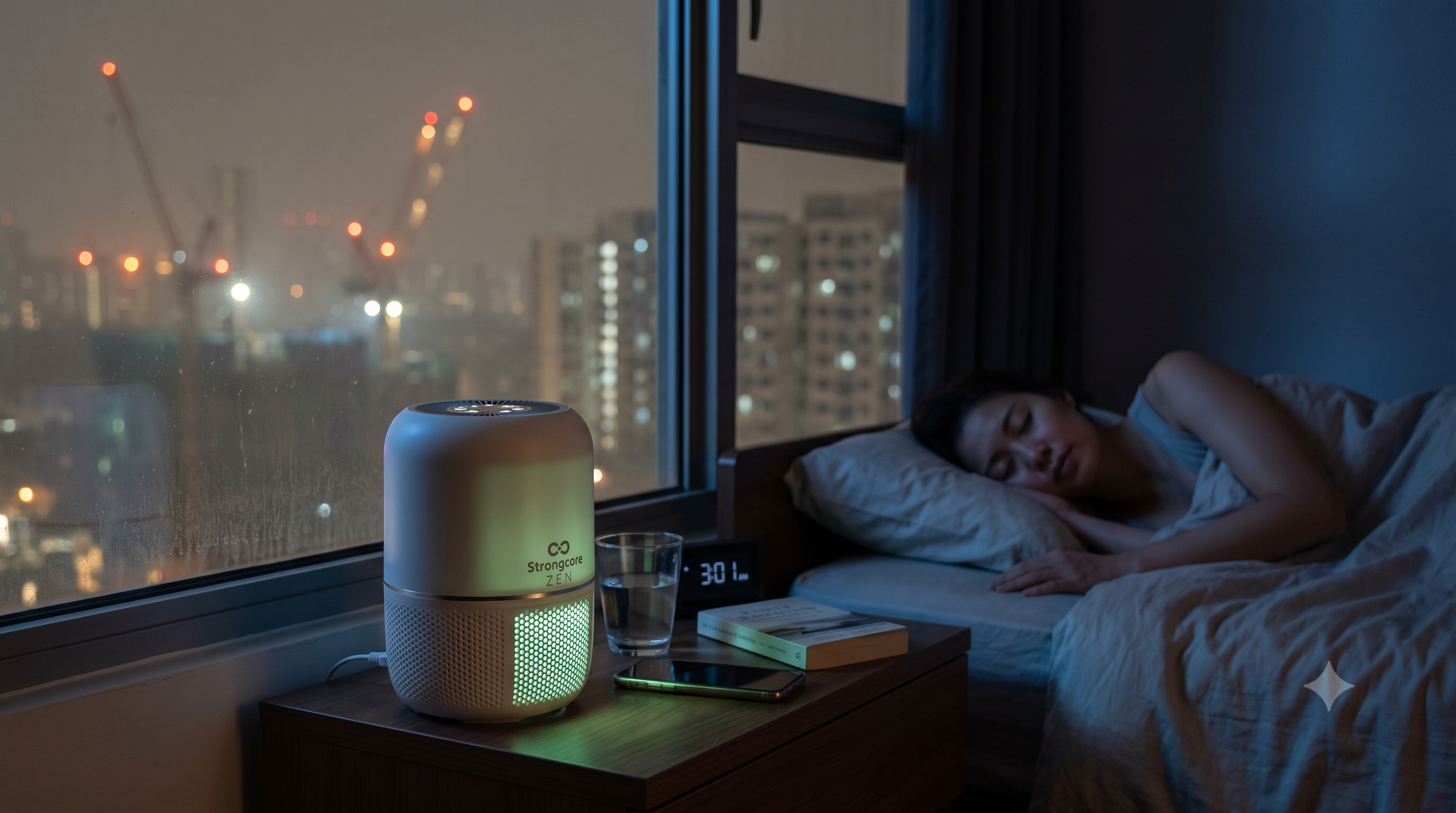

It's 3 a.m. You wake up to a tight chest and that familiar wheeze. You reach for the inhaler on the nightstand — the same one you used at your desk yesterday when the construction site next door kicked up a cloud of dust. On the walk to the MRT this morning, the diesel fumes made your throat close up. And you already know that once haze season hits, it gets worse.
If you have asthma in Singapore, you're not imagining it. Three things are working against your lungs every single day: construction dust from the endless BTO and MRT projects, traffic emissions if you live near an expressway, and transboundary haze that spikes PM2.5 to "Unhealthy" levels for weeks at a stretch.
Here's what most people get wrong: you spend the money on antihistamines, keep the windows shut, and wipe down surfaces daily — but the trigger is a particle 30 times smaller than a strand of hair, and it's already inside your home. Most air purifiers can't catch it. Many are rated HEPA 10 or lower, which lets fine PM2.5 slip straight through the filter and back into the air you breathe.
By the end of this article, you'll know exactly which triggers matter in Singapore, why your current setup may be letting you down, and how to build a genuinely clean-air room at home — without the guesswork.

The 4 Asthma Triggers Hiding in Your Singapore Home
You can't fix what you can't see. These are the four that do the most damage indoors — and why keeping the windows closed isn't enough.
1. Construction dust (the invisible one)
Singapore is a permanent worksite. If there's a BTO, condo, or MRT line going up within a few blocks, fine dust is drifting into your unit through door gaps, aircon vents, and every time you open a window. It settles on your laptop by Tuesday even after you cleaned on Sunday — and the particles small enough to reach deep into your airways are the ones you'll never see on a surface.
2. Traffic emissions (if you live near a main road)
Live beside the PIE, CTE, or any busy arterial road, and you're breathing PM2.5 from diesel exhaust — even with windows shut. That faint smell of fumes in the bedroom isn't harmless; it's fine particulate matter that inflames asthmatic airways and triggers night-time attacks.
3. Haze season (June to October)
Every haze season, the PSI creeps into "Unhealthy" and stays there. Wet towels on the window sill and staying indoors don't stop PM2.5 — the particles are far too small. For many asthmatics, haze months mean broken sleep, more inhaler use, and the real fear of ending up in A&E.
4. Everyday indoor allergens
Dust mites in Singapore's humidity, pet dander, and mould spores in poorly ventilated rooms are constant background triggers. On their own they're irritating; stacked on top of dust and haze, they push sensitive airways over the edge.
Why Most Air Purifiers Won't Protect an Asthmatic
Buying "an air purifier" isn't the same as buying protection. Here's where the cheap ones fail — and what to look for instead.
They use the wrong grade of filter
Most budget purifiers claim "HEPA filtration" but quietly use HEPA 10 or 11, which only capture around 85% of fine particles. What buyers regret: they find out too late that their purifier was recirculating the very PM2.5 that triggers their attacks.
Strongcore ZEN and EDEN use medical-grade HEPA 13 — the same filtration standard used in hospitals — capturing 99.97% of particles down to 0.3 microns. That's construction dust, haze PM2.5, pollen, and pet dander, removed before it reaches your lungs.

They can't handle fumes and odours
A HEPA filter alone traps particles but does nothing for gaseous traffic fumes, smoke, or cooking odours that also irritate airways. Purifiers without a carbon stage leave that smell — and the irritation — right where it was.
Both ZEN and EDEN pair HEPA 13 with an activated carbon layer that absorbs smoke, exhaust fumes, and stubborn odours, so the air is genuinely cleaner, not just quieter.
They don't react when pollution spikes
A purifier that runs at one fixed speed does nothing extra when the haze rolls in or the construction crew starts up. You're left guessing whether it's even working.
The Smart Auto Mode on both models detects air-quality spikes in real time and ramps up automatically, while the smart display shows you live readings — so you can actually see the numbers drop instead of hoping.
They're too loud to run overnight
Night-time is when asthma attacks strike, so the purifier needs to run while you sleep. Cheap units at 55–60 dB force you to choose between clean air and rest — so you switch them off, defeating the point.
ZEN and EDEN run as low as 30 dB — quieter than a whisper — so they stay on all night, every night, without disturbing your sleep.
Which Strongcore Purifier Is Right for You?
You don't need to overthink this. Match the room to the model:

Still unsure? Answer a couple of quick questions about your room size and we'll point you to the right model
Common Questions Before Buying
"Is it worth it compared to a cheaper purifier?"
A $60 purifier that uses HEPA 10 and can't remove PM2.5 isn't cheaper — it's money spent on a device that doesn't stop your triggers. ZEN and EDEN use medical-grade HEPA 13 with filters that last up to 6 months, so you're paying once for filtration that actually works, not replacing a false economy every year.
"How much does maintenance cost?"
The filter lasts up to 6 months of daily use, and a built-in filter sensor tells you exactly when to change it — no guessing whether you're breathing through a clogged filter or replacing it too early and wasting money.
"Will it really make a difference for my asthma?"
The smart display shows your air quality improving in real time, so you don't have to take it on faith. Singapore office workers dealing with construction dust have reported cutting their inhaler use dramatically once their room air was properly filtered.
"Won't it be too loud at night?"
At 30 dB on quiet mode, ZEN and EDEN are quieter than a whisper — softer than the hum of an aircon. You can run either all night without it interrupting your sleep or a Zoom call.

Breathe Easier at Home — Starting Tonight
You're here because you want to stop reaching for the inhaler at 3 a.m., not because you want another gadget that overpromises.
Most air purifiers fail asthmatics because they use a weaker filter grade that lets fine PM2.5 straight through — you weren't doing anything wrong, you just had the wrong device.
Strongcore ZEN and EDEN don't guess. Medical-grade HEPA 13 removes 99.97% of construction dust, haze PM2.5, and allergens; an activated carbon layer absorbs traffic fumes and smoke; Smart Auto Mode reacts the moment pollution spikes; and at 30 dB it runs quietly all night, every night.
Haze season returns every year — and construction dust and traffic fumes never take a break. The sooner your room is properly filtered, the sooner you stop losing sleep to your own home's air.
Choose ZEN for your bedroom or EDEN for your living room, and give your lungs a room they can actually rest in. Shop Strongcore Purifiers


Share:
The Sunday Ritual That Changed Our Family: Meal Prep as Quality Time (Yes, Really)
I Owned a Whisk, a Chopper, and a Blender. This One Gadget Replaced All Three