


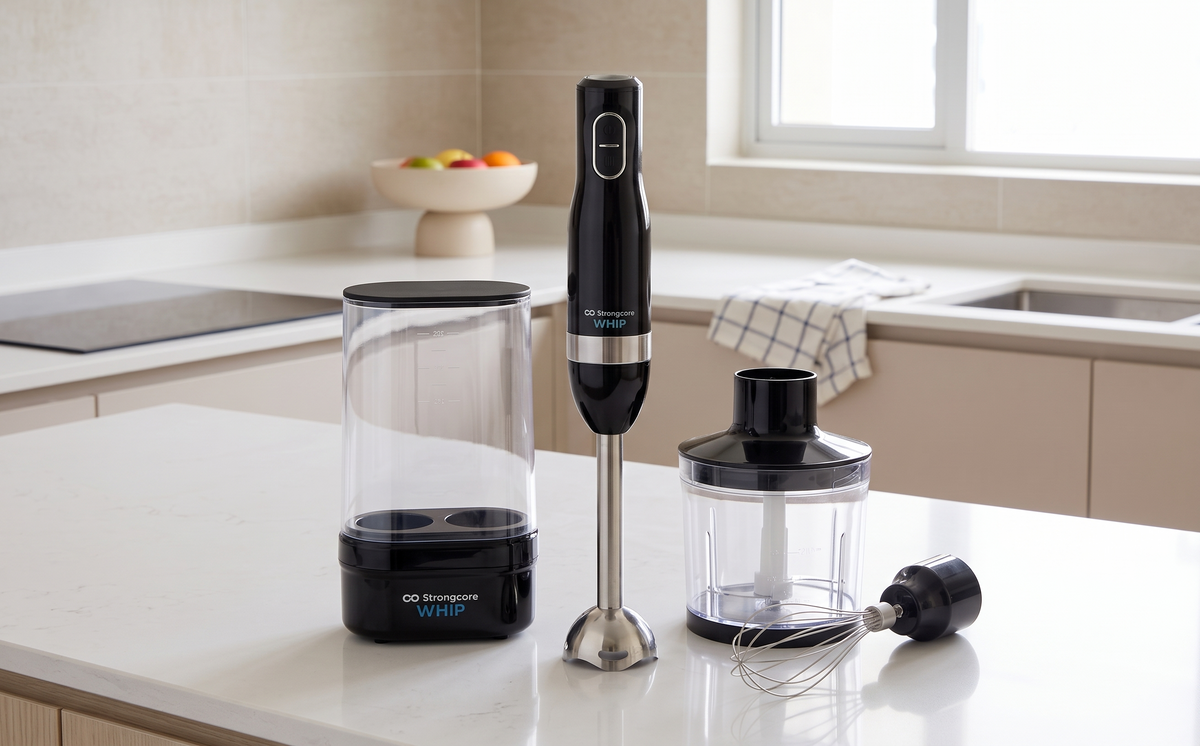

It's a Saturday morning and you're on your knees in front of the bottom kitchen cabinet, one hand holding back a blender jug so the chopper bowl doesn't fall out, the other hand feeling around for a whisk you're fairly sure is behind both of them. You wanted to make pancakes. You've now spent four minutes excavating.
If you cook in an HDB or condo kitchen, you know the pattern:
-
The blender jug wins the space war. It's tall, it doesn't stack, and it holds the shelf hostage
-
The chopper bowl has a lid that lives somewhere else entirely — usually behind the rice cooker
-
You bought the electric whisk for one recipe and it has been used twice since
-
Every gadget needs its own washing routine, so you avoid using any of them on weeknights
What nobody tells you when you're buying your first kitchen gadgets is that you're not buying three tools — you're buying three motors. Three motors, three sets of parts, three cleaning routines, three chunks of cabinet space. And each one only works for one job.
By the end of this, you'll know whether a 3-in-1 hand blender can genuinely replace all three in your kitchen — and where the honest limits are, because there are some.
The Cabinet Audit: What Those Three Gadgets Actually Cost You
Before you count dollars, count shelf space. Here's what a typical three-gadget setup takes up versus one hand blender set:
|
Three separate gadgets |
One 3-in-1 hand blender |
|
|
Appliances stored |
Blender jug + base, chopper bowl + base, electric whisk |
One motor unit, three attachments |
|
Shelf space |
Most of a full cabinet shelf |
21.5 × 14.5 × 24.5 cm |
|
Loose parts floating in drawers |
Lids, blades, whisk beaters |
All of it inside the 1L beaker |
|
Motors that can fail |
Three |
One |

What “3-In-1” Actually Means in Practice
Most multi-function gadgets fail because the extra functions are afterthoughts — a flimsy whisk attachment that can't hold speed, or a chopper bowl so small it's useless beyond one clove of garlic. You end up back with the single-purpose machines anyway, having paid for both.
People buy on the number in the name and only later realise which of the three jobs the machine is genuinely good at.
Here's what each attachment on the Strongcore WHIP is actually built for:
① The whisk — beating eggs, whipping cream, mixing butter for batters. 304 stainless steel, so it rinses clean without holding residue, and no plastic beaters to warp.
② The masher / blending shaft — soups blended straight in the pot, baby purée, smoothies, sauces. This is the immersion-blender function: you bring the blade to the food instead of pouring hot soup into a jug.
③ The chopper — meat, garlic, onions, spices, nuts. The job most people keep a separate mini chopper for.
All three run off one 400W DC motor. DC matters more than the wattage number: DC motors deliver power more efficiently and run cooler and smoother than the cheap AC motors in budget stick blenders, which is a large part of why those burn out inside a year.
Attachments pop off and swap in seconds — which is the difference between "I'll use it" and "I can't be bothered."
The Two-Speed Press-And-Hold Control (And Why It’s a Safety Feature, Not a Gimmick)
Most cheap hand blenders use a fixed on/off switch. Flick it on and it stays on — including if it slips out of your hand, or if a child presses it while it's plugged in on the counter.
WHIP uses press-and-hold across two speeds. It runs while your finger is on it and stops the instant you let go. In practice that means:
-
Speed 1 for starting — no splatter when you drop the shaft into a full pot of soup or start whipping cream
-
Speed 2 for finishing — full power for smooth purées, stiff peaks and tougher chopping
-
Release to stop — instant, every time
It also gives you the texture control that matters in real cooking: a quick pulse for chunky sauces, a longer run for a completely smooth purée.
Worried about noise in a flat with thin walls? WHIP runs at ≤85 dB — quiet enough for a 6am smoothie or blending during a nap without waking the household.

Where Three-In-One Honestly Falls Short
A fair guide has to name the limits, so here they are.
A hand blender is not a stand mixer. If you're making bread dough weekly, or creaming butter and sugar for large bakes, buy a stand mixer. The whisk attachment is for eggs, cream and batters — not kneading.
It's not a large food processor. If you slice, shred or grate in volume — mandoline-style discs, kilos of cabbage — a full processor with discs is the right tool.
It's not an ice crusher. Frozen fruit in a smoothie is fine. Whole ice cubes, repeatedly, will punish any hand blender.
Everything else — soups, sauces, purées, baby food, smoothies, whipped cream, chopped garlic, minced meat, spice pastes — is squarely inside what a 3-in-1 handles.
Which Setup Is Right for Your Kitchen?
Get the 3-in-1 hand blender if you…
-
Cook in an HDB or condo kitchen with limited cabinet space
-
Are setting up a first home and want to buy once
-
Make soups, sauces, smoothies or baby food regularly
-
Already own gadgets you use twice a year and want them gone
-
Want one machine your partner or helper will actually use without instructions
Keep the separate machines if you…
-
Bake heavily every week (keep the stand mixer)
-
Process large volumes of vegetables regularly (keep the food processor)
Buy nothing if you…
-
Cook from packets and use a kettle. Be honest — that's fine
For most Singapore households, one motor and three attachments covers everything they actually cook, and frees a shelf while doing it.

The Questions People Ask Before Buying
"Is a hand blender actually useful, or will it end up in the cupboard too?"
The ones that get used are the ones that are easy to reach and easy to clean. WHIP is 1.3 kg, stores in a single beaker, and rinses under the tap in seconds. It's the low-friction option, which is the only kind that survives past month two.
"Can it really replace my chopper?"
Yes — the chopper attachment handles meat, garlic, onions and spices. It's the same job your mini chopper does, minus the second base unit taking up space.
"Will 400W be enough?"
For soups, purées, smoothies, whipped cream and chopping, comfortably. DC motors convert power more efficiently than the AC motors in cheaper units, so the number understates the real-world performance. It won't replace a 1,000W countertop blender for daily ice crushing — nothing in this category will.
"Is it safe around children?"
The press-and-hold control means it cannot run unattended — release your finger and it stops immediately. Store the blade attachments inside the beaker, out of reach.
"What if it stops working?"
1-year free-replacement warranty. Not a repair queue — a replacement unit.

You're here because your kitchen has three gadgets doing three jobs, and you'd rather have one doing all three.
Most multi-function gadgets fail because two of the three functions are token extras. That's not a sign you chose badly — it's a sign the machine was designed around a price, not around cooking.
WHIP doesn't guess at it. A 400W DC motor built for efficiency, not just a big number on the box. 304 stainless steel blades and whisk that resist rust and stay sharp. Two speeds on a press-and-hold control that stops the moment you release. ≤85 dB. Every attachment stores inside the 1L food-grade beaker. 1.3 kg, 21.5 × 14.5 × 24.5 cm — one shelf, not one cabinet. Backed by a 1-year free-replacement warranty.
If you're setting up a new home or clearing out a kitchen, do it before the next big cook, not during it — the point of consolidating is fewer decisions on a busy weeknight, and that only starts once it's on your counter.
Get the WHIP or Chat with us to check it fits how you cook


Share:
Asthma Triggers in Singapore (And How to Protect Your Lungs at Home)
I Bought Minced Meat Every Week for Years — Then I Did the Math on Grinding My Own