


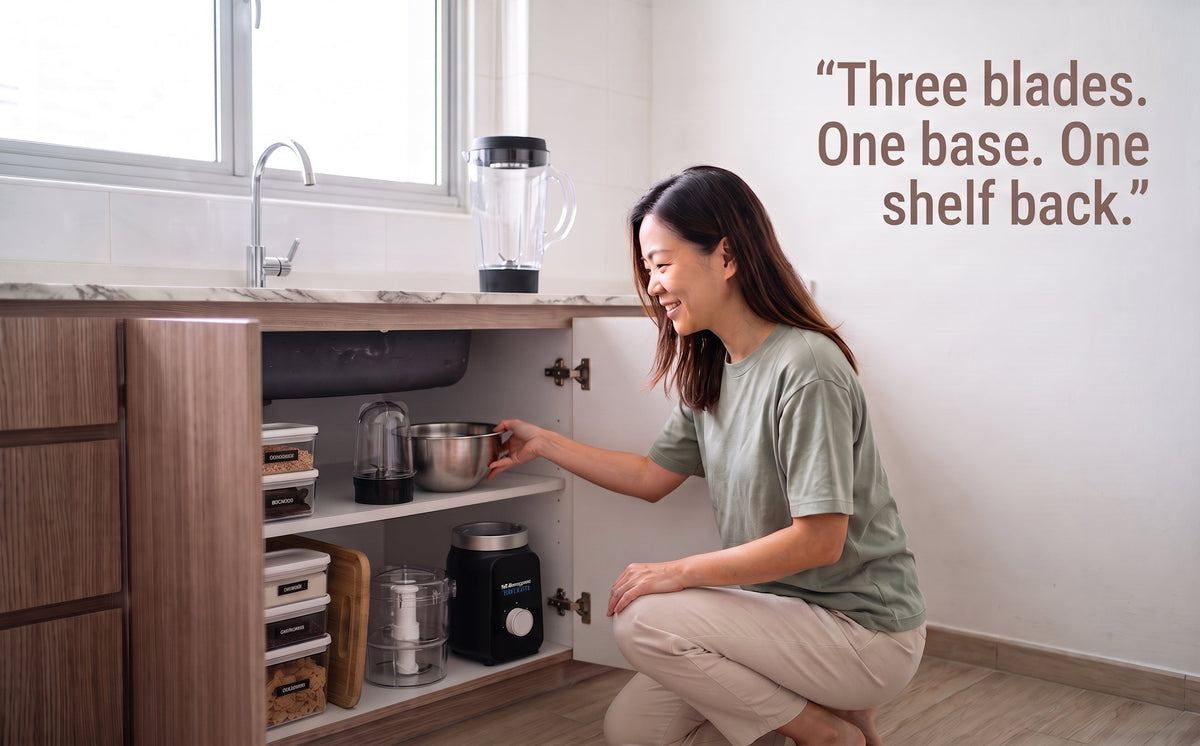

Open the cabinet under your counter. Go on.
There's a blender jug on its side because it won't stand up under the shelf. There's a chopper bowl with the lid stored separately, because the lid doesn't fit on the bowl when it's stacked. And somewhere at the back, behind the rice cooker, is a coffee grinder you bought in a burst of enthusiasm and have used four times.
Three machines. Three sets of parts. One shelf, completely gone.
The pattern is always the same:
-
You buy a blender first, discover it turns garlic and onion into slurry instead of chopping them, so you buy a chopper
-
The chopper can't handle dry ingredients, so peppercorns and coffee beans need a third machine
-
Each one costs S$40–90, so you've spent well over S$150 assembling a set that was never designed as a set
-
Two of the three get used monthly at best, but all three occupy space permanently
Here's what the category doesn't tell you: the reason one machine can't do all three jobs isn't the motor. It's the blade. Blending, chopping and grinding need genuinely different blade geometry, and a single fixed blade in a single fixed jar will always be a compromise at two of the three.
By the end of this post you'll know exactly which of those three machines you can consolidate, which ones you can't, and what to check on a listing before you believe a "3-in-1" claim.
Why Most “Multifunctional” Blenders Aren’t
The typical 3-in-1 listing gives you one motor base, one blade, and three differently sized jars. That's not three functions — that's one function at three volumes.
Put dry spices in a jar with a blending blade and you get uneven grit: some powder, some whole peppercorns, nothing consistent. Put garlic in it and you get paste. The machine technically ran. The result was wrong.
What buyers regret not knowing: they compared jar counts and wattage across listings, and never checked whether the blades were actually different from each other.
The Strongcore TRITON runs three jars with three purpose-built blade attachments: a four-blade 3D assembly for wet blending, an S-shaped two-blade for dry grinding, and a single-shape blade for chopping. The 1L jar handles drinks and smoothies, the 500ml bowl does prep — onion, garlic, chilli, meat — and the 300ml cup grinds beans, nuts and spices dry.
Same 380W base. Three genuinely different tools on top of it. Want to see which jar handles which job?

The Dry-Grinding Test That Separates Real From Marketing
This is the single fastest way to judge a food processor in Singapore, and it takes ten seconds on a product page: look for a dedicated dry-grinding cup and a separate grinding blade. If the listing doesn't show one, the machine cannot grind coffee or whole spices properly — no matter what the title says.
Wet blades are designed to create a vortex in liquid. With no liquid present, dry ingredients just get flung to the walls and sit there while the blade spins in empty air.
TRITON's 300ml grinder cup pairs an S-shaped blade with a narrow chamber, so beans and peppercorns keep dropping back into the blade path. That's what produces an even grind instead of a mix of powder and whole seeds.
For a Singaporean kitchen this is the attachment that quietly does the most work: rempah, dried chilli, belacan, peppercorns, coffee, nuts for kueh — all of them dry, all of them impossible in a blending jar.
Power That Doesn’t Stall on the Hard Jobs
Budget multi-jar sets tend to fail on the third jar. The motor manages a smoothie, coughs through chopped onion, and then stalls or overheats on nuts and dried spices, which are the densest thing you'll ever ask it to do.
You find this out on the one occasion you actually needed it — usually mid-recipe, usually with guests coming.
TRITON runs a 380W AC motor at 24,000 RPM with 304 stainless steel blades across all three attachments. The 304 grade matters for the chopper bowl in particular: it's the food-contact stainless that resists corrosion and pitting after repeated contact with acidic ingredients like chilli, lime and onion. Cheaper blade steel dulls and stains within months.
Two speeds plus pulse give you the control the single-switch machines don't: pulse for a coarse onion chop you can still see, speed 2 held down for a fine paste.
Comparing TRITON against buying three separate machines?
What It Actually Costs You in Space
A blender, a chopper and a grinder bought separately occupy three footprints and, realistically, three storage locations — which is why you stop using two of them.
TRITON is one base at 1.76kg, 34 × 13.5 × 25cm. The jars nest for storage. Every part except the motor base detaches for washing, and the whole thing runs at ≤85 dB, which matters in an HDB kitchen where the machine is six feet from someone sleeping.
There's also a safety layer the budget sets skip: an auto safety lock that only lets the motor run when a jar is properly seated and twisted into place. With children in the kitchen — or with your own hands near an exposed grinding blade — that's the difference between a design feature and an accident.
TRITON is Safety Mark tested, stocked in Singapore, and carries Strongcore's 1-Year SwiftSwap warranty: it gets replaced, not repaired and returned six weeks later.

Which Setup Is Actually Right for Your Kitchen?
If you blend drinks, prep aromatics, and grind spices or coffee → TRITON 3-in-1 (all three jobs, one base, one shelf)
If you cook Singaporean or South Asian food regularly → TRITON 3-in-1 (the 300ml grinder cup is the attachment you'll use most — rempah, dried chilli, whole spices)
If you're setting up a first kitchen and buying from scratch → TRITON 3-in-1 (one purchase instead of three, and you skip the two-year process of discovering what you're missing)
If you only ever make smoothies and nothing else → you don't need three jars. A single 600ml personal blender is the right-sized, cheaper answer, and we'd rather tell you that than sell you two attachments you'll never open.
If you knead dough, slice vegetables, or shred cheese in volume → this isn't your machine. Those need a full-size processor with a feed chute and disc attachments. TRITON blends, chops and grinds — it doesn't slice or knead, and we won't pretend otherwise.
Common Questions Before Buying
"Is a 3-in-1 just three mediocre machines instead of one good one?" It depends entirely on whether the blades differ. A shared blade across three jars is a compromise. Three purpose-built blades sharing one motor is a genuine consolidation — the motor was never the specialised part. Check the blade photos on any listing before you believe the label.
"Will 380W handle coffee beans and nuts?" Yes, in the 300ml grinder cup, which is sized so dense ingredients stay in the blade path. Work in short pulses rather than one long run — that's true of every grinder at any wattage, and it produces a more even result.
"How much of a hassle is swapping between jars?" Twist the jar off, swap the blade attachment, twist the new jar on. A few seconds. The auto safety lock means the machine won't run mid-swap, which is the reason the swap is safe rather than fiddly.
"What's the maintenance?" None on a schedule. No filters, no consumables. Every part except the motor base detaches and washes by hand. Dry the grinder cup fully before storing — dry attachments and residual moisture are what dull blades over time, on any brand.

One Shelf Back, Three Jobs Covered
You came here because your kitchen has been colonised by single-purpose machines, and you want to cook without the cabinet Tetris.
Most multi-jar sets fail because they change the jar size and keep the blade the same — so you end up back where you started, buying a separate grinder within the year. You weren't careless. The category is genuinely misleading on this one point.
TRITON is specified where it counts: 380W AC motor at 24,000 RPM. Three purpose-built 304 stainless blade attachments. 1L blending jar, 500ml chopper bowl, 300ml dry-grinding cup. Two speeds plus pulse. Auto safety lock. ≤85 dB. 1.76kg. Safety Mark tested, stocked in Singapore, backed by a 1-Year SwiftSwap replacement warranty — no repairs, no chasing.
Three blades, one base · Auto safety lock · 1-Year SwiftSwap replacement. Get TRITON now!


Share:
I Bought a S$300 Blender and Use It Twice a Year. Here's What I Reach for Instead
The 2-Minute Morning Smoothie That Replaced My S$9 Juice Bar Habit