



It's 8:12am. You're already walking faster than you'd like, and the queue at the juice bar is four people deep. You order the same thing you order every morning. Card, tap, S$8.90. You take three sips on the escalator, the rest goes warm on your desk by 10am, and you do it all again tomorrow.
Here's what that actually looks like when you stop scrolling past the notification:
-
S$8.90 a smoothie × 5 weekdays = S$44.50 a week. Roughly S$180 a month.
-
Seven to nine minutes of queueing on the mornings you least have it to spare.
-
You have no idea what's in it. Most juice bar blends run on fruit juice concentrate, sorbet bases and syrup. That "healthy" 500ml cup can carry more sugar than a can of soft drink.
-
You still eat something else at 10am, because a juice on an empty stomach doesn't hold anyone until lunch.
The obvious answer is to make it at home. Most people try. Most people quit within three weeks — and it's almost never about willpower.
Home smoothies fail because of the blender, not the person. Underpowered motors stall on frozen fruit. Cheap blades leave gritty bits of spinach and chewy chunks of mango. And the wash-up — jug, lid, blade collar, gasket, then decanting it into a tumbler — turns a 2-minute job into a 12-minute one.
By the end of this, you'll know exactly which five recipes take two minutes flat, what to look for in a smoothie blender so it doesn't end up in the cupboard, and roughly how fast the switch pays for itself.
The Real Cost Comparison: Juice Bar vs. Your Kitchen
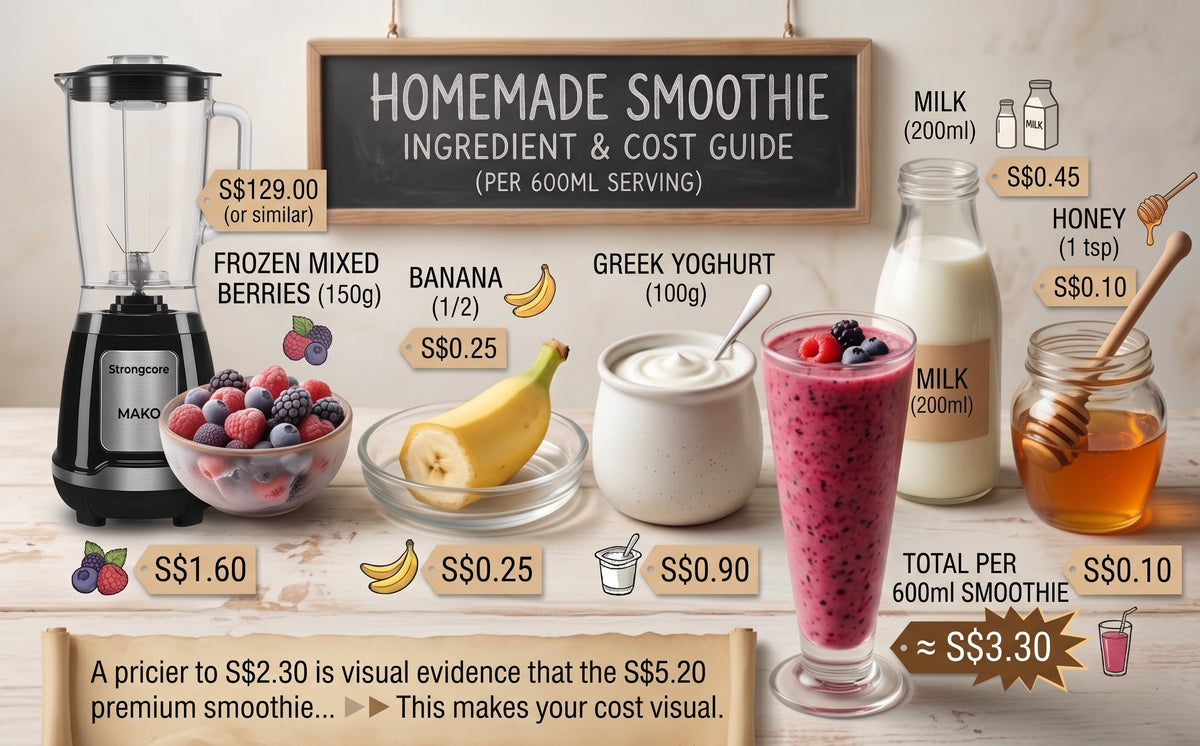
Here's what a 600ml smoothie costs when you build it yourself, using regular supermarket prices in Singapore:
|
Ingredient (per serving) |
Approx. cost |
|
Frozen mixed berries (150g) |
S$1.60 |
|
Banana (½) |
S$0.25 |
|
Greek yoghurt (100g) |
S$0.90 |
|
Milk (200ml) |
S$0.45 |
|
Honey (1 tsp) |
S$0.10 |
|
Total per 600ml smoothie |
≈ S$3.30 |
Against a S$8.90 juice bar cup, that's S$5.60 saved per smoothie. Five mornings a week is S$28 a week — about S$112 a month.
And the swap gets better, not worse: your version is 600ml instead of 500ml, has actual protein and fibre in it, and you decide exactly how much sugar goes in.
The payback question everyone asks: divide the price of your blender by S$5.60. That's how many weekday mornings it takes to break even. For most people making a smoothie every workday, a good personal blender pays for itself inside a month — and every cup after that is money back in your pocket.
See the MAKO price and work out your break-even

Why Most People’s Home Smoothie Habit Dies in Week Three
The problem: underpowered motors that stall on the good stuff
Most cheap smoothie blenders are built for soft fruit and nothing else. They'll handle a ripe banana, then bog down the moment frozen mango or a few ice cubes go in. You hear the motor drop in pitch, you stop it, shake the jar, start again. Two or three cycles later you've got a lukewarm, half-blended cup and a blender that smells faintly of burning.
What buyers regret not knowing: they compared blenders on price and jar size, then discovered the only variables that actually matter are motor quality and RPM.
How MAKO fixes it: MAKO runs a 250W pure copper motor at 24,000 RPM. Copper windings hold their power output over years of daily use instead of fading the way cheap motors do after a few months. Frozen fruit, ice and oats go in and come out as one smooth pour — no stopping, no shaking, no re-blending.
Trusted by Singapore households who blend every single morning, not twice a year.
The problem: chunks, grit and fibrous bits
Blades are where budget blenders quietly cut corners. Low-grade steel dulls within months and starts pushing food around the jar instead of cutting through it — which is why your spinach ends up as green flecks and your dates end up as chewy lumps at the bottom.
What buyers regret not knowing: "high wattage" on the box means nothing if the blade can't cut. Blade grade and geometry do half the work.
How MAKO fixes it: Four-tip 304 stainless steel blades create a 360° vortex that pulls everything back down into the cutting zone. 304 stainless is anti-corrosion, so the edges stay sharp and hygienic through daily use — no rust ring, no dulling, no grit.
The problem: the wash-up nobody budgets for
A full-size jug blender is a 12-minute commitment. Blend, decant into a tumbler, dismantle the jug, wash the blade collar, dry the gasket, find somewhere to put a 2-litre jug that doesn't eat your entire counter. Do that at 7am for a week and you'll go back to the juice bar.
What buyers regret not knowing: capacity feels generous in the shop and becomes a chore at home. Almost nobody making one or two servings needs 1.5 litres.
How MAKO fixes it: the 600ml jar is the cup. Blend in it, twist the blade base off, cap it, take it with you. One vessel, one rinse. The whole unit weighs 0.79kg and stands compact enough to live on the counter permanently — which matters more than any spec, because appliances you have to lift out of a cupboard are appliances you stop using.
The problem: blending at 6am without waking the flat
Typical blenders run past 90dB — genuinely loud enough to wake a partner through an HDB wall or cut a baby's nap short. Plenty of people push their smoothie to the weekend for exactly this reason, which is how the habit dies.
How MAKO fixes it: ≤85dB low-noise operation, with an anti-skid base that stops the rattle and walk you get from a light blender on a hard countertop. Quiet enough for a 6am blend before anyone else is up.
The Five 2-Minute Recipes (600ML Each)
All five fit a 600ml jar. All five take one blend cycle. The prep trick: portion your fruit into freezer bags on Sunday, so weekday mornings are dump-and-blend.
1. Berry Bounce-Back — the everyday one Frozen mixed berries 150g · banana ½ · Greek yoghurt 100g · milk 200ml · honey 1 tsp Roughly S$3.30. The direct replacement for the S$8.90 cup.
2. Green Commuter — the one that doesn't taste like a lawn Baby spinach 40g · frozen pineapple 100g · green apple ½ · banana ½ · coconut water 250ml Pineapple does the heavy lifting on flavour. 24,000 RPM is what stops the spinach showing up as flecks.
3. Banana-Oat Breakfast — the one that actually holds you to lunch Banana 1 · rolled oats 3 tbsp · milk 250ml · peanut butter 1 tbsp · cinnamon · 3 ice cubes Oats and nut butter add the fibre and fat a juice bar cup doesn't have. This is the one that stops the 10am snack run.
4. Tropical Reset — the weekend-feeling weekday Frozen mango 120g · frozen pineapple 80g · banana ½ · coconut milk 80ml · water 150ml · squeeze of lime Frozen-fruit heavy, no ice needed. A real test of whether your blender can cope.
5. Post-Gym Protein — the shake that isn't lumpy Protein powder 1 scoop · banana 1 · frozen berries 80g · milk 300ml · nut butter 1 tbsp Powder clumps in a weak blender and grits on the tongue. High RPM plus a 4-tip blade dissolves it properly.

Which Blender Is Actually Right for You?
If you're blending one or two servings a day and want to drink from the jar → MAKO (600ml jar doubles as your tumbler, 0.79kg, one rinse)
If you're feeding a family of five and batch-making soup → a full-size 1.5–2L jug blender. Be honest about whether that's actually your week.
If your kitchen is a corner of an HDB flat and counter space is the real constraint → MAKO (compact enough to leave out, which is the only way daily habits survive)
If you blend at 6am with a sleeping partner or baby in the flat → MAKO (≤85dB, anti-skid base)
If you only make a smoothie when guests come over, twice a year → honestly, don't buy anything. Use the juice bar.
Common Questions Before Buying
"Is it worth it compared to a S$25 Shopee blender?" A S$25 unit that dies in eight months and gets replaced twice is S$75 plus two rounds of hassle — and every morning in between is a stalled, chunky blend. MAKO uses a pure copper motor and 304 stainless blades built for daily use, backed by a 1-Year Swiftswap warranty: a free replacement, not a repair queue.
"Will 250W really handle frozen fruit and ice?" Yes — because wattage alone isn't the number that matters. 250W of pure copper motor spinning at 24,000 RPM through four-tip 304 stainless blades delivers more usable cutting force than a higher-wattage unit with a cheap motor and blunt steel. Frozen mango, ice cubes, oats and nut butter all go in one cycle.
"How long does the cleaning actually take?" Under a minute. Half-fill the jar with warm water and a drop of detergent, run one short pulse, rinse. There's no separate tumbler to wash because you drank from the jar.
"Is it loud enough to wake the household?" It runs at ≤85dB — a normal blender sits above 90dB. A 20–30 second blend at 6am with the kitchen door shut won't clear the flat. The anti-skid base also stops the countertop rattle that's often louder than the motor itself.
"Is it safe with kids around?" MAKO uses a twist-to-lock system — the motor only runs when the jar is properly locked onto the base. It won't spin on an open or half-seated jar.

The Honest Bottom Line
You came here to stop paying S$9 for a cup you don't finish — not to buy another appliance that ends up behind the rice cooker.
Most home smoothie habits fail because the blender stalls on frozen fruit, leaves grit in the cup, and creates a wash-up nobody has time for at 7am. That's not a discipline problem. That's the wrong tool.
MAKO doesn't guess. 250W pure copper motor. 24,000 RPM. Four-tip 304 stainless anti-corrosion blades. A 600ml food-grade jar you blend in and drink from. 0.79kg with an anti-skid base. ≤85dB. Twist-to-lock safety. 1-Year Swiftswap free-replacement warranty.
The maths doesn't move: S$5.60 saved per morning, roughly S$112 a month. Every week you delay is another S$28 across the counter at the juice bar.
Start on a Monday. Portion five freezer bags on Sunday night, and the decision stops being a decision.


Share:
Blender, Chopper, Grinder: I Replaced Three Machines With One 3-Jar Set
The $29.90 Vacuum That Quietly Handles the Everyday Mess