


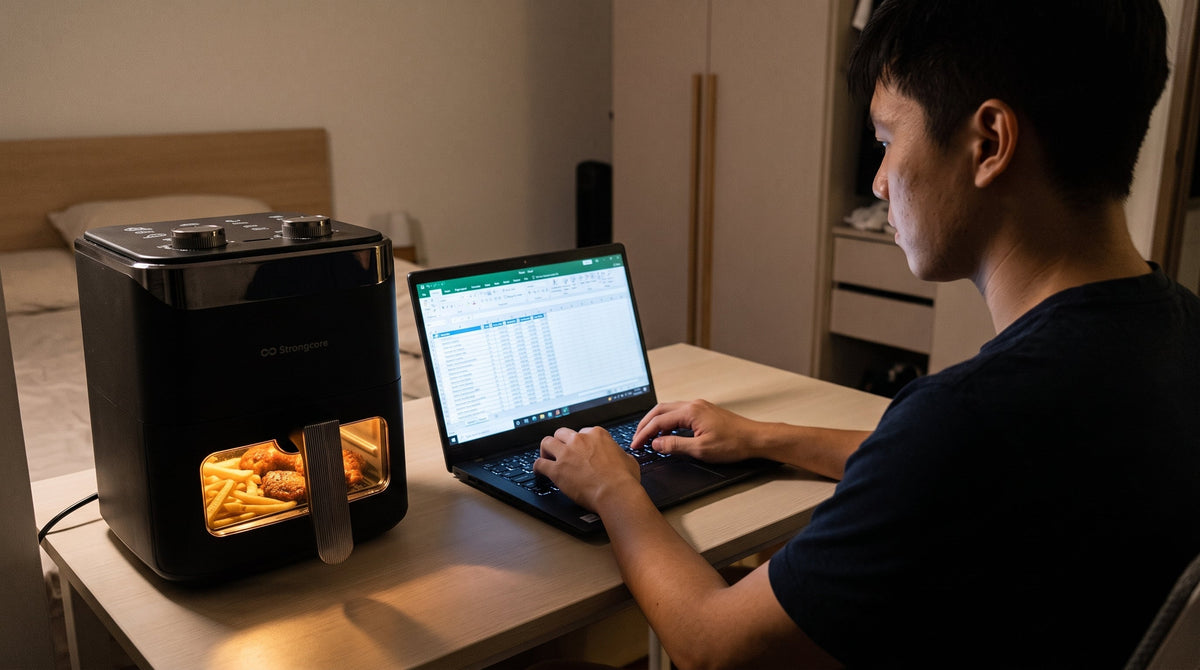

It's 8pm on a Tuesday. You've just got back to your rented room in Bedok. The shared kitchen has one housemate frying fish, another waiting behind him with a pot, and a sink stacked from lunch. You stand in the doorway for about four seconds, do the maths on how long that queue will take, and go back to your room to open Grab.
That's S$12 for a meal you didn't want, plus S$5 delivery, plus service fees. Again.
If you rent a room in an HDB flat, this is the actual shape of the problem:
-
Your room has a desk, a bed, and maybe a shelf. There is no counter. The desk is your office, your dining table and your workspace at the same time.
-
Kitchen access is technically allowed but practically awkward. Three housemates, one hob, and everyone hungry between 7 and 9pm.
-
You're spending S$10–15 per meal eating out twice a day. On a graduate salary, with S$800–1,200 already going to rent, that's the line item that hurts.
-
You've looked at air fryers before and every one you found was either a 5L family unit that wouldn't fit anywhere, or a S$50 Shopee model with reviews you didn't trust.
Here's what nobody tells you: most small air fryers aren't designed for a room. They're designed for a kitchen that happens to be small. That's a different problem. A kitchen appliance assumes a counter, a socket at counter height, ventilation, and somewhere to put the basket when you pull it out. A room appliance has to work on a desk, next to a laptop, in a space you also sleep in.
By the end of this article you'll know exactly how people are setting up a cooking corner in a 100–150 sq ft room, what specs actually matter when there's no counter, and which size air fryer is right for your situation — including when not to buy one.
Start Here: Which Setup Actually Fits Your Room?
Before the detail, the short version. Find your situation:
|
Your situation |
What to get |
Why |
|
You rent a single room, no kitchen access |
Strongcore COMPACT 3.5L |
34 × 23cm footprint sits on a desk or shelf; manual dials mean no setup |
|
You share a kitchen with 2–3 housemates |
Strongcore COMPACT 3.5L |
Small enough to carry back to your room and store there — no shared counter claim |
|
You cook for two, and you have a real counter |
Strongcore CORE 5L |
Digital touchscreen, 7 cooking modes, 1500W |
|
You cook for a family or batch-prep on Sundays |
Strongcore MAX 8L |
8L capacity, 10 modes, defrost and dehydrate functions |

Problem 1: You don't have a counter. You have a desk.
Most "compact" air fryers are only compact compared to a family model. A 5L unit is typically 36–40cm wide and needs clearance above the lid for steam. On a 60cm desk that already holds a monitor and a laptop, it doesn't just fit badly — it doesn't fit.
What buyers regret not knowing: people compare capacity in litres and forget that the number that matters is footprint. You can't judge a 3.5L against a 5L on volume alone. You have to measure your desk.
The Strongcore COMPACT 3.5L measures 34 × 23 × 33cm. The footprint is roughly an A4 sheet of paper with a little margin around it. It stands 33cm tall, which clears most desk shelves and slots under a standard wall unit. The 3.5L basket handles portions for 1–2 people — a chicken thigh and a tray of vegetables, or a full plate of frozen items, in one go.
That's the whole point of the size. You're not compromising on a family fryer. You're buying the right tool for one person's dinner.
Problem 2: The shared kitchen isn't a kitchen. It's a scheduling problem.
Most cheap air fryers have a solid basket with no window. So you cook blind. You pull the drawer out at minute 8 to check, again at minute 12, again at minute 15 — and every time you do, you drop the internal temperature and add time.
In your own kitchen that's a minor annoyance. In a shared flat, it means you have to physically stand there for the entire cook. You can't start something and go back to your room, because you have no idea what's happening inside. So you hover in a kitchen where a housemate is waiting for you to finish. That's the real reason people stop cooking in flatshares — not the cooking, the standing around.
The COMPACT is fitted with a heat-resistant see-through glass window and a built-in timer alarm. You can see the food going golden without opening anything, and the timer rings once when it's done. Combined with the small footprint, that means the whole appliance can live in your room, plugged into your own socket, entirely outside the shared-kitchen queue.
No negotiating for counter space. No waiting for the hob. No kitchen politics.
See the COMPACT vs CORE vs MAX feature comparison
Problem 3: You've never really cooked, and preset buttons make it worse
Digital air fryers sell on preset counts — 7 modes, 10 modes, 12 modes. If you grew up eating hawker food and have genuinely never cooked, those presets aren't a feature. They're twelve decisions you don't have the experience to make. Chips at "chicken" setting? Frozen gyoza at "bake"? You end up guessing anyway.
What buyers regret not knowing: they pay a premium for modes they never touch, then discover the touchscreen is the first thing to fail — and it's the part you can't work around.
The COMPACT has two manual knobs. One for temperature, one for time. That's the entire interface. 200°C for 15 minutes gets you crispy anything. There is nothing to learn, nothing to misread, and no screen to stop responding. The window teaches you the rest — you literally watch food cook and learn what "done" looks like.
It runs at 1250–1400W with 360° hot air circulation, so heat is even and preheating is quick. Trade-off to know upfront: the COMPACT has no cooking presets and no defrost or dehydrate function. If you want those, you want the CORE or MAX. If you want dinner, you want two dials.
Problem 4: You're leaving a hot appliance running in the room you sleep in
This is the one people don't say out loud. A cheap unbranded fryer sitting on a wooden desk, next to a laptop, in a room with fabric and paper everywhere — that's a legitimate thing to feel uneasy about.
The COMPACT includes overheating protection, a built-in safety lock, and automatic shut-off when the outer pot is detached — meaning if you pull the basket out, the heating element stops. The tray is removable and non-stick, made with food-safe materials, so cleanup is a rinse rather than a scrub. That matters when your nearest sink is shared.
It's also backed by a 2-Year Swiftswap Warranty: free replacement, no repairs, local Singapore support. If it fails, you don't post it anywhere or wait weeks for a repair queue — you get a replacement unit.

The Actual Setup: Building a Cooking Corner in a Rented Room
This is what people are doing, in order:
1. Pick your surface. A desk edge, a low shelf, or a S$20 folding side table from IKEA. You need 34 × 23cm of clear space plus about 20cm in front to pull the basket out. Keep it away from curtains and off the bed.
2. Check your socket. At 1250–1400W, run it directly from a wall socket, not off a daisy-chained extension shared with a kettle. This is the single most important safety step and it costs nothing.
3. Put a heat mat or a wooden board underneath. Protects the desk, and gives you a landing spot for the hot basket when you pull it out.
4. Stock the freezer, not the fridge. Frozen items are what this appliance is best at, and they don't spoil while you're out. From FairPrice or Giant: frozen chicken thighs, fish fillets, gyoza, hash browns, spring rolls, potato wedges, mixed vegetables. A week of dinners for roughly S$25–35.
5. Learn three settings and stop there.
-
200°C / 15–18 min — frozen chicken, wedges, anything you want crispy
-
180°C / 10–12 min — fish, gyoza, reheating yesterday's rice-bowl protein
-
160°C / 8 min — eggs, toast-adjacent things, warming up leftovers without drying them out
6. Keep a bin liner and kitchen roll in the room. The reason people abandon desk cooking isn't the cooking. It's realising they have to walk to the shared bin every night.
That's it. No hob, no oil, no queue, no negotiating with anyone.
Common Questions Before Buying
"Is S$39.90 actually worth it versus just eating out?"
A hawker or delivery dinner runs S$10–15. A home-cooked air fryer dinner runs about S$3–5. That's roughly S$8 saved per meal you cook instead of buy. The COMPACT pays for itself in about five home-cooked dinners — under a week if you cook most evenings. Currently S$39.90, down from S$41.90.
"What will it cost to run?"
At 1250–1400W, a 20-minute cook uses roughly 0.47kWh. At Singapore household rates of around S$0.30 per kWh, that's about 14 cents per meal. Cook every evening and you're looking at roughly S$4 a month in electricity. There are no filters, no pods, and no consumables to replace — ever.
"Will my landlord or housemates have a problem with it?"
Air frying uses circulated hot air rather than a pan of oil, so it produces far less smoke and lingering odour than stovetop frying. It's an enclosed electric appliance with auto shut-off, which is generally what "no heavy cooking" clauses are trying to prevent. Worth doing anyway: send your landlord a one-line message before you buy. Most say yes immediately, and you've removed the deposit risk entirely.
"What if it's too small once I actually start cooking?"
3.5L comfortably handles 1–2 portions — that's a protein plus a side, in one basket, in one go. If you regularly cook for two or batch-prep for the week, be honest with yourself now and go to the CORE 5L instead. Buying the wrong size is the most common regret in this category, and it's entirely avoidable.
Which Strongcore Air Fryer Is Right for You?
If you rent a single room with no kitchen access → COMPACT 3.5L (34 × 23cm footprint, fits a desk, manual dials)
If you share a kitchen with housemates and want your own setup → COMPACT 3.5L (small enough to store in your room, window means no hovering)
If you cook for two on a proper counter → CORE 5L (digital touchscreen, 7 cooking modes, 1500W)
If you batch-cook or feed a family → MAX 8L (10 modes, defrost and dehydrate, stainless steel)
You Didn’t Want a Hobby. You Wanted Dinner
You're here because you want to eat a proper meal in your own room without queuing for a shared hob or paying S$17 for delivery — not because you want to become a cook.
Most small air fryers fail renters for one reason: they're built for kitchens, not rooms. Too wide for a desk, blind baskets that force you to stand over them, and touchscreens that break first. You weren't doing anything wrong. You had the wrong size appliance for the space you actually live in.

The Strongcore COMPACT 3.5L is specified for exactly this situation. 34 × 23 × 33cm. 1250–1400W with 360° hot air circulation. A see-through glass window and timer alarm so you can start dinner and go back to work. Two manual dials — nothing to learn, nothing to fail. Overheating protection, safety lock, and auto shut-off when the basket is out. Available in black or white, so it doesn't look like an appliance parked in your bedroom.
It's currently S$39.90 (down from S$41.90), with 30-day free returns and a 2-Year Swiftswap Warranty — free replacement, no repair queue, local Singapore support. Ready stock in Singapore.
If you're mid-lease and eating out twice a day, every week you wait costs more than the appliance does.


Share:
Plastic vs. Glass Food Processor Bowls: Why the Cheap One Kept Smelling Like Garlic
Why Your Cheap Hand Blender Died in 6 Months (And What to Buy Instead)