



It's Tuesday night. You open the cabinet, pull out the food chopper you bought eight months ago, lift the lid — and there it is. Garlic. Faint, stale, unmistakably last week's. You washed it. You washed it twice. You even left it out in the sun on the yard rack for an afternoon, because your mother swore that works.
You're about to chop onions for a soup, and the bowl still smells like the chilli you minced for sambal.
If you've owned a cheap plastic-bowl chopper, you know the pattern:
-
Month one: perfect. Clear bowl, sharp blade, no complaints
-
Month three: the bowl has gone slightly cloudy and hairline scratches have appeared where the blade sits
-
Month five: garlic smell survives washing-up liquid, and there's a faint orange tint on the underside from turmeric or curry paste
-
Month eight: you stop using it for anything you'll eat raw, because you don't quite trust it
What nobody tells you when you're comparing food processors in Singapore is that the bowl is the part that fails first — not the motor. Listings advertise wattage, blade count and speed settings. Almost none of them tell you what the bowl is made of, how thick it is, or how it holds up after two hundred washes in a humid kitchen.
By the end of this, you'll know exactly why plastic bowls hold on to smells, which material suits your cooking, and how to spot the difference on a product page before you spend the money.
Which Bowl Material Is Actually Right for You?
Front-load the decision, because it's simpler than the marketing makes it look:
If you mostly chop garlic, chilli, onion, ginger and belacan → choose glass. These are the strong-smelling aromatics that permanently scent plastic. Glass is non-porous, so the smell rinses off instead of soaking in.
If you handle raw meat and fish regularly → choose glass. Scratched plastic gives bacteria somewhere to sit. A smooth, hard surface is far easier to get genuinely clean.
If you need something feather-light to lift one-handed → plastic wins on weight. A 2L glass bowl is heavier. That's the honest trade-off, and it's the only category where plastic is genuinely better.
If you're grinding coffee beans or hard spices → neither. Buy a dedicated grinder cup. Chopper bowls of any material aren't built for it.
For most Singapore home cooks — the ones whose weekly cooking runs on garlic, chilli, shallots and minced meat — glass is the straightforward answer.

Why Plastic Bowls Hold Smells (And Washing Harder Won’t Fix It)
Most budget food processors use plastic bowls because plastic is cheap to mould and cheap to ship — it survives the courier, it costs a fraction of glass, and it lets a listing hit a S$20 price point. The problem isn't the price. It's that food-grade plastic is slightly porous and much softer than steel.
Every time the blade spins, it makes microscopic scratches. Oils from garlic, chilli, onion and curry paste settle into those scratches. Detergent is water-based; those compounds are oil-based. The washing-up liquid slides over the top of them.
People buy on wattage and blade count, then discover eight months later that the part they can't replace is the part that went wrong. You can't buy a new bowl for a S$20 chopper. You replace the whole unit.
Three things happen to a plastic bowl, in order, and none of them are your fault:
-
Scratching. Blade contact and stirring with metal spoons abrade the surface
-
Staining. Turmeric, chilli, tomato and beetroot pigments bind to the roughened plastic
-
Odour retention. Aromatic oils lodge below the surface, where a sponge can't reach
Sunning it helps a little. Baking soda paste helps a little. Neither reverses the scratching, which is what caused it.
What a Glass Bowl Actually Changes
Glass is non-porous. There is nowhere for oil to soak into, which is why a glass bowl that has just minced garlic goes back to smelling of nothing after a rinse. It's also much harder than plastic, so the blade doesn't score it, so it doesn't go cloudy at month three.
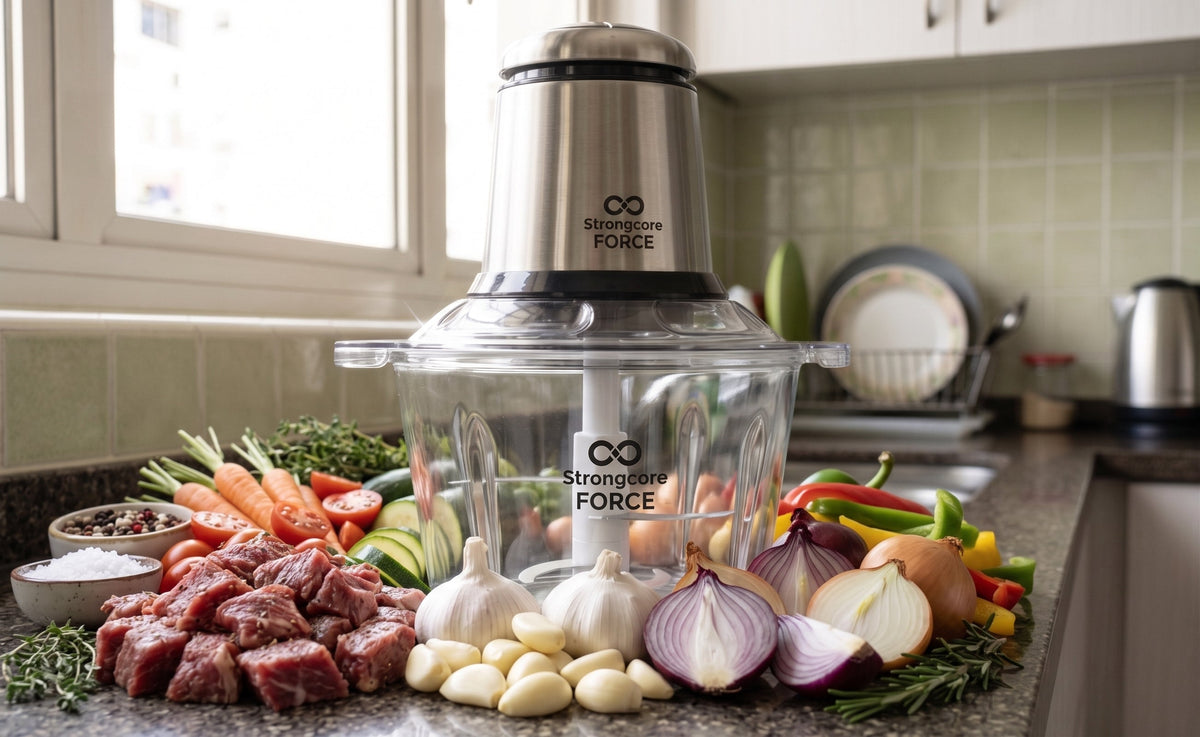
The Strongcore FORCE uses a 2L glass bowl as its main container, with the blade unit seating on a centre shaft inside it and a transparent cup cover locking on top before the motor unit engages. Practically, that means:
-
Smells don't carry over. Chop garlic tonight, chop fruit tomorrow, no ghost of last night's sambal
-
Stains don't set. Turmeric and chilli rinse off a hard, smooth surface rather than binding to it
-
The bowl stays clear. You can see what's happening inside, which matters for texture control — coarse for chunky, fine for paste
-
It doesn't scratch under the blade. The failure that starts the whole plastic cycle simply doesn't begin
-
Weight works in your favour. A heavier bowl stays put on the counter while you push through a dense grind, instead of skating around
The plastic parts that remain — the cup cover and housing — are BPA-free. That's where the phrase actually belongs, and it's worth reading listings carefully enough to notice when a seller applies it to glass to pad a spec list.
Sold in Singapore with local support and covered by Strongcore's SwiftSwap warranty — free replacement, no repair queue.

The Odour Test — Run It Before You Trust Any Bowl
Ten minutes, and it settles the argument for whichever chopper you already own:
-
Mince four cloves of garlic. Empty the bowl
-
Wash with warm water and washing-up liquid, exactly as you normally would
-
Rinse and dry
-
Put your nose right into the bowl
A glass bowl smells of nothing. A plastic bowl that's been in service a few months smells of garlic, and it will still smell of garlic tomorrow morning.
Then look at the base under a bright light and tilt it. Fine circular scratches where the blade sits, faint cloudiness, a yellow or orange cast in the corners — that's the surface your food has been touching.
If your bowl fails this test, it isn't a cleaning problem, and no amount of scrubbing will fix it.
Cleaning, Honestly
The FORCE is designed to come apart quickly: unplug it, lift off the motor unit, remove the cup cover, then carefully lift out the blade unit — the edges are genuinely sharp, so handle them by the hub.
Two things worth knowing before you buy, because plenty of listings won't tell you:
It is not dishwasher safe. The glass bowl, cup cover, blade unit, egg beater and spatula are all hand-washable in warm soapy water. The motor unit and cord must never be submerged. If a dishwasher cycle is non-negotiable for you, that's a real reason to look elsewhere.
Clean it after every use, not at the end of the week. Residue left on the blade unit dulls cutting efficiency over time — that's straight from the manufacturer's own troubleshooting guidance for uneven grinding results.
The upside is that hand-washing glass is a rinse, not a scrub. There's no trapped odour to work at.
Worried it's fiddly to maintain? Five parts, warm soapy water, no filters to buy and nothing to replace on a schedule.

Common questions before buying
"Is a glass bowl worth paying more for than a S$20 plastic one?"
Work it per year. A cheap plastic-bowl chopper that becomes unpleasant to use at month eight is roughly S$30 a year of ownership, because you can't buy a replacement bowl for it. A unit whose bowl doesn't degrade is a single purchase. The FORCE sits at [S$26.90 — verify against live listing], which is the same money as one cycle of the cheap version.
"How much can it actually handle in one go?"
Up to 500g of meat, cut into 1–2cm pieces, and no more than two minutes of continuous running before the motor needs to cool. For a family batch of dumplings or meatballs that's one or two rounds — and with a glass bowl, "another round" doesn't mean another round of scrubbing.
"Will it really stop the smell, or is that marketing?"
Run the ten-minute garlic test above on your current bowl, then on a glass one. It's a materials property, not a claim: non-porous surfaces have nowhere for aromatic oils to go. And if the unit itself ever fails, the SwiftSwap warranty sends a replacement rather than putting you in a repair queue.
"Won't the glass break the first time I knock it?"
It's a thick, purpose-made bowl, not drinkware, and it sits on a stable base while running. It is still glass — treat it like a good pot rather than a plastic tub. Locally supported, and replaceable under warranty if something goes wrong.
You're here because your chopper smells of garlic and you want the next one not to — not another appliance that quietly becomes unpleasant to use.
Most cheap food processors fail at the bowl, not the motor. Soft plastic scratches, scratches trap aromatic oils, and oils don't come out with washing-up liquid. You weren't cleaning it wrong. You had the wrong material.

The Strongcore FORCE doesn't guess at this. A 2L glass bowl that doesn't scratch, stain or hold odour. A blade unit that lifts out for hand-washing in warm soapy water. A safety interlock so the motor only runs when the cup cover is locked in place. Two speeds — one for soft ingredients, one for dense. Egg beater and spatula included. CPSO certified, and covered by the SwiftSwap warranty: send a video, we verify, a replacement arrives at your door. No repair, no chasing.
If you're already avoiding your current bowl for anything you'll eat raw, that decision is effectively made — you just haven't replaced the machine yet. Do it before the next big cook, not during it.


Share:
The $29.90 Vacuum That Quietly Handles the Everyday Mess
How to Cook Real Meals in an HDB Room With Zero Counter Space